摒
Character Story & Explanation
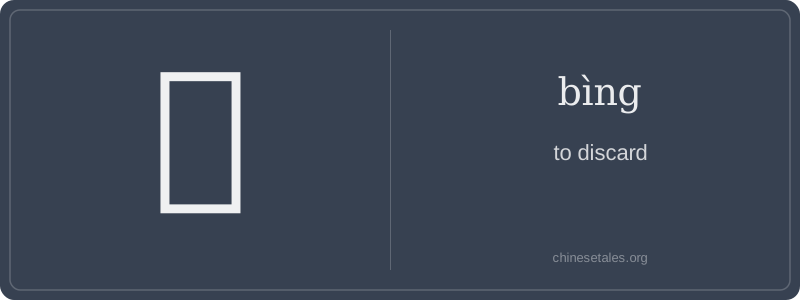
Oracle bone inscriptions show no direct precursor for 摒 — it’s a later invention, likely Warring States or Han dynasty, built deliberately from existing elements. Visually, it merges 扌 (hand radical, left) with 屏 (bǐng, 'to shield/hold one’s breath') on the right. Early seal script shows the hand radical clearly gripping an abstract barrier; over centuries, the right side simplified from 屏’s full form (a person beside a wall) into today’s streamlined 屏 — where the 'door' component (户) morphed into the top two strokes and the 'person' (卩) became the bottom 尸-like shape. Every stroke serves purpose: the three dots in 扌 are fingers pushing; the vertical line in 屏 is the spine bracing against what’s being rejected.
The meaning evolved from 屏’s original sense of 'suppressing breath to stay hidden' (as in 屏息, bǐngxī, 'to hold one’s breath') — then extended metaphorically to 'suppressing ideas' and finally to active, physical discarding. By the Tang dynasty, poets like Bai Juyi used 摒弃 in moral contexts, e.g., '摒弃浮华' ('discard superficiality'). The character’s visual duality — hands acting + breath held — captures its essence: discarding isn’t passive loss; it’s a conscious, embodied act of self-discipline, like exhaling poison from your lungs.
At its core, 摒 (bìng) carries the visceral, decisive energy of *forceful rejection* — not just 'throwing away' but *pushing aside with both hands*, clearing mental or physical clutter with intention. It’s a literary and formal verb, rarely heard in casual speech; you’ll find it in editorials, philosophical essays, or solemn speeches — never in 'I’ll toss this banana peel.' Its radical 扌 (hand) signals physical action, while the right side 屏 (bǐng) hints at suppression or holding back, giving the compound meaning 'to push away and silence' — like shutting a door on unwanted thoughts.
Grammatically, 摒 is almost always transitive and followed by 手 (shǒu, 'hand') in the fixed phrase 摒弃 (bìngqì), meaning 'to discard utterly' — e.g., 摒弃偏见 (bìngqì piānjiàn, 'discard prejudice'). Unlike common verbs like 丢 (diū, 'to lose/throw'), 摒 implies moral or intellectual agency: you don’t 摒 trash — you 摒 outdated ideologies. Learners often mispronounce it as bǐng (confusing it with 屏), or mistakenly use it alone without 弃 — but 摒 never stands solo in modern usage.
Culturally, 摒弃 is loaded with Confucian and Marxist echoes: Mao used it in speeches urging abandonment of 'feudal superstitions'; today, environmental campaigns say 摒弃一次性用品 ('discard single-use items'). The character feels weighty, even righteous — which is why using it for trivial things (e.g., 'I 摒 my old socks') sounds comically grandiose. Its power lies in its rarity: it appears only when the stakes feel high.