掴
Character Story & Explanation
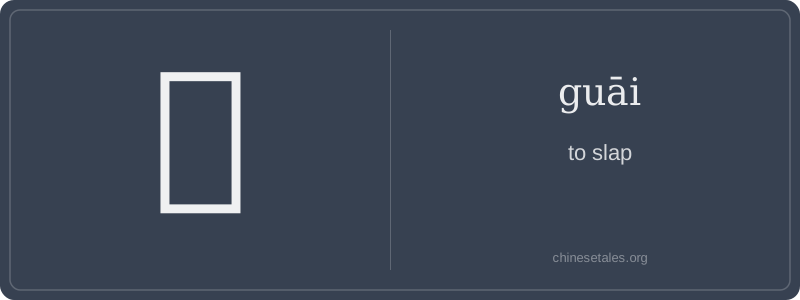
The earliest form of 掴 appears in late Warring States bamboo slips — not as a pictograph, but as a semantic-phonetic compound already: left side 扌 (hand radical), right side 瓜 (guā, 'melon'), chosen for sound resemblance to guāi. But why 瓜? Scholars suspect ancient scribes borrowed its shape because the rounded, slightly lopsided outline of 瓜 evoked the *curved arc of a swinging palm* — not the fruit itself, but the motion’s contour. Stroke by stroke, the modern form solidified: three hand strokes (扌), then 瓜’s six strokes — dot, vertical, two curved hooks, horizontal, and final dot — totaling eleven, mirroring the abruptness of a slap.
By the Tang dynasty, 掴 appears in poetry and legal documents describing corporal discipline — always intentional, always personal. In the 14th-century novel Water Margin, a hero ‘掴倒恶霸’ (guāi dǎo èbà, ‘slapped the tyrant down’) — not punched, not kicked, but *slapped*, underscoring contemptuous dominance. The visual logic holds: 扌 asserts agency, 瓜 implies the round, forceful sweep of the hand — no weapon, no delay, just raw, unmediated contact. That fusion of motion and sound has held for over 2,300 years.
At its core, 掴 (guāi) is a visceral, onomatopoeic slap — not a gentle pat or formal reprimand, but the sharp, stinging impact of an open palm hitting flesh. It’s emphatically physical and emotionally charged: think indignation, punishment, or sudden shock. Unlike the neutral 打 (dǎ), which covers everything from typing to fighting, 掴 zeroes in on that specific *sound* and *sensation*: the crisp ‘slap!’ — almost like the English ‘whap’ or ‘smack’. You’ll rarely see it in polite conversation; it thrives in literature, drama, and heated dialogue where bodily immediacy matters.
Grammatically, it’s a transitive verb requiring a direct object (e.g., 掴他一巴掌), often paired with measure words like 巴掌 (bāzhǎng, 'palm') or 耳光 (ěrguāng, 'ear-light' = slap across the face). Learners sometimes wrongly use it as a standalone verb ('He slapped') without specifying *what* was slapped — but 掴 demands precision: 掴脸 (guāi liǎn, 'slap the face'), 掴肩膀 (guāi jiānbǎng, 'slap the shoulder'). It can’t mean 'to hit with a tool' (that’s 拍 or 敲); it’s *hand-only*, skin-to-skin.
Culturally, 掴 carries moral weight — in classical texts, it signals righteous anger or disciplinary authority (e.g., a master slapping a careless apprentice). Modern usage leans dramatic or satirical: news headlines might say ‘网民怒掴键盘’ (netizens angrily slap their keyboards) — hyperbolic, vivid, and unmistakably 掴. A common mistake? Confusing it with 瓜 (guā, 'melon') due to the right-hand component — but remember: 扌 + 瓜 isn’t fruit; it’s fury made flesh.