摎
Character Story & Explanation
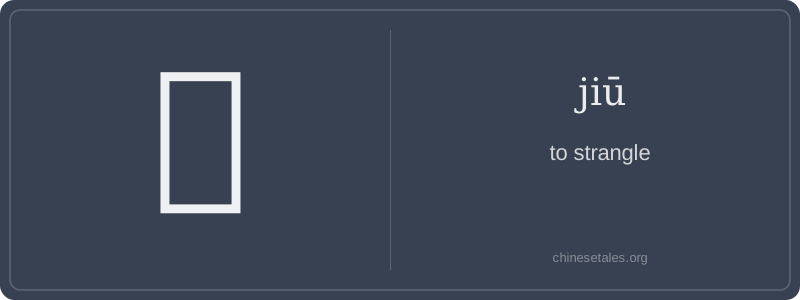
The earliest form of 摎 appears on Warring States bronze inscriptions as a composite pictograph: left side showed a hand (扌, the 'hand' radical), right side depicted a coiled rope or twisted cord wrapped around a stylized neck — sometimes even with a knot drawn explicitly. Over centuries, the rope evolved into the phonetic component 纠 (jiū), which itself means 'to entwine' or 'to twist', while the hand radical solidified as 扌. By the Han dynasty clerical script, the knot had simplified into the top strokes of 纠, and the neck element vanished — leaving only the implication of constriction through twisting force.
This visual logic shaped its semantic journey: from concrete 'twisting rope around neck' → 'manually constricting throat' → 'strangling'. It appears in the *Shuōwén Jiězì* (121 CE) as 'to bind tightly and cut off breath', cited alongside execution methods in Zhou rites. Interestingly, the same root 纠 later gave rise to words like 纠纷 (jiūfēn, 'dispute') — where 'entwining' metaphors extend from physical strangulation to social entanglement. The character never softened; its form and function remained unflinchingly literal across 2,300 years.
At its core, 摎 (jiū) is a visceral, almost archaic verb meaning 'to strangle' — not just any choking, but a deliberate, forceful act of cutting off breath by constricting the neck. It carries weight: think ancient battlefield executions, classical legal texts, or dramatic opera scenes. Unlike common verbs like 勒 (lēi, 'to throttle'), 摎 implies direct manual pressure — hands gripping, fingers digging in. You’ll rarely hear it in daily speech; it’s literary, historical, and often grim.
Grammatically, 摎 is a transitive verb requiring a clear object (e.g., 摎住他 — 'strangle him'). It’s almost never used in progressive or perfective aspects with 了/过 in modern writing; instead, it appears in tightly packed classical-style clauses: 摎而杀之 ('strangled and killed him'). Learners mistakenly try to use it like 碰 or 打 — but 摎 has no casual register. No 'I accidentally 摎’d the cat' — that’s biologically impossible and linguistically forbidden.
Culturally, this character lives in the shadows of early Chinese law and historiography. In the *Zuo Zhuan*, it appears in accounts of aristocratic punishments; in Han dynasty legal bamboo slips, it denotes capital acts distinct from beheading or poisoning. Modern learners often misread it as 抠 (kōu, 'to dig') or 鸠 (jiū, 'pigeon') due to visual similarity — a mix-up that turns a murder into birdwatching. Its absence from HSK isn’t oversight: it’s a lexical relic, preserved not for utility, but for precision in reconstructing how pre-Qin society named violence.