摀
Character Story & Explanation
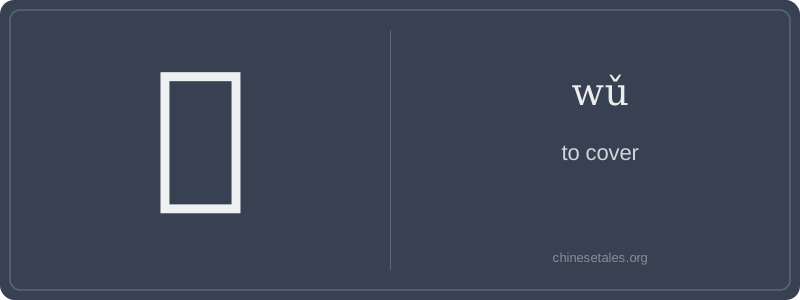
The earliest form of 摀 appears in late Warring States bamboo slips, not oracle bones — and its composition is brilliantly literal. The left side 扌 (hand radical) anchors it as a manual action, while the right side 五 (wǔ, 'five') was not originally a number! In ancient script, 五 looked like two crossed lines (✕) symbolizing 'interlacing' or 'complete enclosure' — think of fingers interlocking to form a tight seal. Over centuries, that crossed shape stylized into the modern 五, and the hand radical solidified its meaning as 'to cover with the hand.' By the Han dynasty, the character had fully stabilized into today’s 13-stroke form.
This visual logic never faded: every stroke reinforces containment — the three dots of 扌 suggest grasping fingers, the horizontal strokes of 五 mimic overlapping layers, and the final捺 (nà) stroke sweeps downward like a lid locking shut. Classical usage shines in Tang dynasty poetry, where 摀 describes monks covering incense burners at dusk ('香炉摀尽月如钩'), evoking quiet ritual and deliberate concealment. Even today, native speakers subconsciously feel its physicality — it’s the word you’d choose not to say 'cover,' but to say 'clamp over, seal off, muffle completely.'
At its heart, 摀 (wǔ) is a vivid, tactile verb meaning 'to cover' — but not the gentle, everyday kind. Think of pressing something firmly over an opening: a lid clamping shut, a hand smothering sound, or fabric tightly draped to block light. It’s emphatic and physical, often implying intentionality and pressure — unlike generic 覆 (fù) or 盖 (gài), which can be neutral or even passive. You’ll rarely see it in casual speech; it lives in literary descriptions, medical texts (e.g., covering a wound), or dramatic dialogue where control or concealment matters.
Grammatically, 摀 is transitive and usually appears before its object, often with aspect particles like 了 or 着: 他用手摀住了嘴 (tā yòng shǒu wǔ zhù le zuǐ — 'He covered his mouth with his hand'). Note the crucial 把 structure isn’t typical here — instead, 摀 + 住 is the go-to pattern to express successful, sustained covering. Learners often mistakenly swap it for 盖, but 盖 implies placement from above (like a blanket), while 摀 suggests active, close-contact sealing — imagine palm-on-face versus quilt-over-body.
Culturally, 摀 carries subtle weight: it appears in classical poetry describing muffled cries, in opera scripts for gestures of suppression, and even in modern psychological writing about emotional inhibition ('covering one’s true feelings'). A common pitfall? Misreading it as wú (like 无) due to tone confusion — but wǔ is third tone, firm and falling-rising, mirroring the motion of pressing down and holding. Its rarity outside formal registers means you’ll mostly encounter it in written contexts — making recognition more valuable than production.