搿
Character Story & Explanation
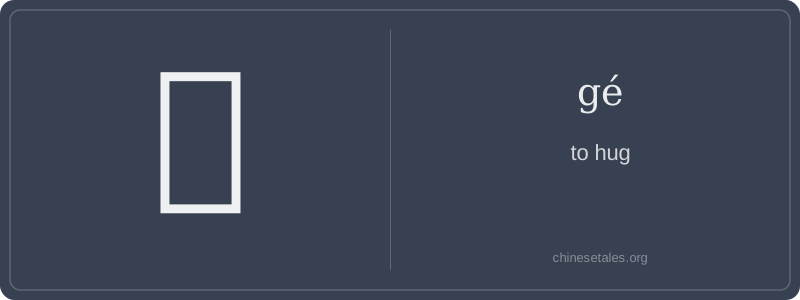
The earliest form of 搿 appears in late bronze inscriptions and seal script as a vivid double-hand motif: two 手 (shǒu, ‘hand’) radicals mirrored around a central element — originally resembling two bent arms clasping a person or object. Over centuries, the left hand simplified into 扌 (the modern ‘hand’ radical), while the right hand merged with the phonetic component 合 (hé, ‘to join’), which itself evolved from a pictograph of a lid fitting snugly onto a vessel. By the clerical script stage, the two hands had fused into the symmetrical, embracing shape we see today: 扌 + 合 = two hands pulling things (or people) together into unity.
This visual logic drove its semantic evolution: from ‘joining by hand’ in early texts (like the *Shuōwén Jiězì*, where it’s glossed as ‘holding tightly’) to the robust, bodily embrace of vernacular literature. In Qing dynasty novels and Northeastern folk storytelling, 搿 appears in scenes of reunion, reconciliation, or even mock combat — always implying active, reciprocal physical engagement. Its pairing with 合 isn’t coincidental: it doesn’t just mean ‘hug’ — it means ‘to join *with your hands*, inseparably’. The character itself looks like arms locking — and that’s exactly what it does.
Imagine two old friends meeting after ten years in a bustling Beijing hutong — no polite nod, no handshake. They just *grab* each other’s arms and squeeze tight, leaning in with cheeks pressed, breath mingling, jackets rumpled. That’s 搿 (gé): not the gentle ‘hug’ of English, but a full-body, almost wrestling embrace — warm, rough, deeply physical, and unapologetically intimate. It’s the hug of laborers, elders, or childhood pals who’ve never learned to hold back. It conveys affection *through force*, not softness.
Grammatically, 搿 is almost always transitive and used in compound verbs: 搿住 (gē zhù, 'to grab-and-hold tightly'), 搿着 (gē zhe, 'hugging/holding on to'), or 搿在一起 (gē zài yī qǐ, 'to clasp together'). You won’t say ‘I 搿 you’ alone — it needs that reinforcing particle or complement. Learners often wrongly use it like 抱 (bào) — but 抱 is tender, neutral, and common; 搿 is regional (strongest in Northeastern Mandarin), colloquial, and emotionally charged — think ‘bear hug’ meets ‘wrestler’s clinch’.
Culturally, 搿 carries warmth without pretense — it’s rarely used between strangers or in formal settings, and almost never romantically (that’s 拥抱 yōngbào). A classic mistake? Using it in writing meant for standard Mandarin — it reads as dialectal or rustic. Also, note the tone: gé (second tone), *not* gě — mispronouncing it as third tone makes it sound like a name or nonsense syllable. This character doesn’t whisper affection — it announces it with knuckles and elbow room.