搴
Character Story & Explanation
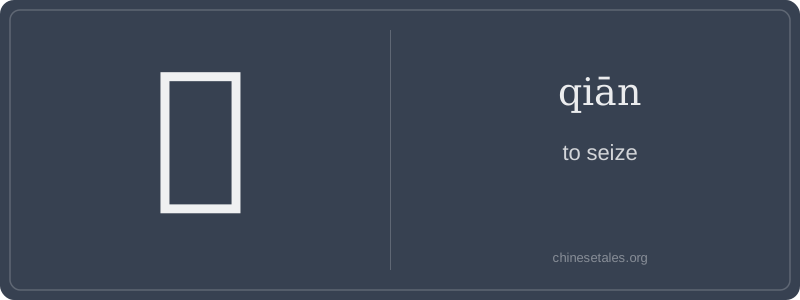
The earliest form of 搴 appears in Warring States bamboo texts—not oracle bones—as a compound pictograph: on the left, 手 (hand radical, later simplified to 扌), and on the right, 寒 (hán, ‘cold’), but not for temperature. Originally, that right side was 寣—a variant depicting a person under a roof, holding a weapon, symbolizing ‘to take by force in a dwelling’. Over centuries, 寣 morphed into 寒 through clerical script simplification, losing its weapon but keeping the sense of ‘taking decisively within a bounded space’. The 14 strokes crystallized by the Han dynasty: 3 for the hand radical, 11 for the phonetic 寒—whose sound (hán) drifted to qiān via Middle Chinese tone shifts and dialectal influence.
This semantic journey—from ‘forcible taking inside a structure’ to ‘seizing something elevated’—reflects how classical Chinese abstracted physical acts into moral metaphors. By the Tang, 搴 appears in Du Fu’s poems describing generals seizing enemy standards, and in Song dynasty essays about scholars ‘seizing virtue’ (搴德) — transforming a martial gesture into ethical aspiration. Its visual duality—hand + ‘cold’—is misleading; the 寒 component is purely phonetic now, yet the chill remains metaphorically: 搴 feels crisp, sharp, and unyielding, like a blade drawn in winter air.
Imagine a Tang dynasty scholar standing at the edge of a mist-shrouded mountain cliff, reaching up—not for a flower, but for a fluttering banner caught high in the wind. His arm extends sharply; his fingers clench mid-air. That precise, urgent motion—grasping something elusive, elevated, or contested—is 搴 (qiān). It’s not casual picking or gentle lifting; it’s a decisive, almost heroic seizure: of banners, of authority, of opportunity. This character pulses with agency and effort—it implies overcoming resistance, height, or distance.
Grammatically, 搈 is nearly always literary or classical. You won’t hear it in daily chat ('I’ll grab lunch'), but you’ll see it in formal writing, historical narratives, or poetic lines. It functions as a transitive verb and often appears in parallel four-character phrases like 搴旗斩将 (‘seize the banner and behead the general’). Learners sometimes misread it as ‘to pick’ like 採 (cǎi), but 搴 carries weight—think ‘snatch with purpose’, not ‘pluck with ease’. It’s also rarely used alone; it prefers compound verbs or classical syntax.
Culturally, 搴 evokes martial valor and scholarly ambition—two pillars of traditional Chinese ethos. In the Chu Ci, Qu Yuan writes ‘搴木兰兮杜若’ (‘I seize magnolia, I gather dendrobium’), where 搴 isn’t botanical but ritualistic: claiming purity through deliberate, elevated action. A common mistake? Assuming it’s interchangeable with 拿 (ná) or 取 (qǔ). But 搴 has no colloquial warmth—it’s stately, archaic, and slightly fierce. Use it wrong, and your sentence gains unintended gravitas—or absurdity.