搲
Character Story & Explanation
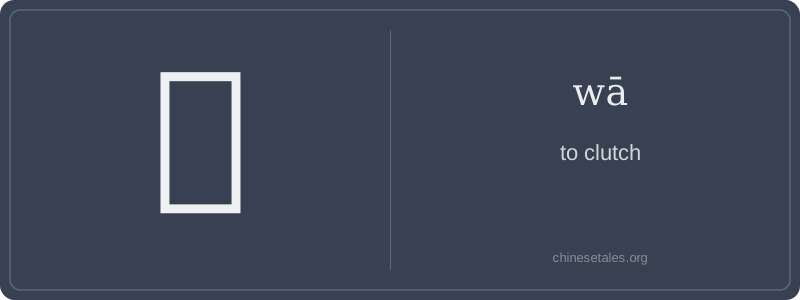
The earliest form of 搲 appears in late Warring States bamboo texts and Han dynasty seals — not as a standalone oracle bone character, but as a semantic-phonetic compound built around 扌 (the 'hand' radical) and 瓦 (wǎ, 'tile/roof tile', serving phonetically). Visually, it’s a masterclass in functional design: the left side 扌 signals manual action; the right side 瓦, though seemingly unrelated to 'clutching', was chosen for its sound (wǎ → wā via tone shift) and subtle visual echo — the curved shape of 瓦 resembles a cupped hand cradling something. Over centuries, clerical script smoothed the angular strokes, and regular script standardized the 12-stroke form we use today.
Its meaning stayed remarkably consistent: from Han dynasty agricultural manuals describing 'scooping millet with bare hands' (《齐民要术》) to Ming vernacular fiction where servants 'wā coins from a sack', 搲 always implied direct, palm-and-finger contact with loose matter. Unlike literary synonyms like 掬 (jū, 'to cup in both hands'), 搲 feels earthy and unrefined — a verb used by farmers, cooks, and children, never scholars or officials. This social texture is baked into its strokes: no elegance, just efficiency.
Think of 搲 (wā) as Chinese’s version of the English verb 'to grab with both hands and a little desperation' — like snatching the last slice of pizza before your roommate notices, or lunging for a falling phone. It’s not just 'take'; it’s tactile, urgent, and slightly messy — often implying fingers digging in, scooping up, or clutching something loose or slippery (rice, sand, coins, even abstract things like 'opportunity'). Unlike generic verbs like 拿 (ná, 'to hold') or 取 (qǔ, 'to obtain'), 搲 carries physical grit: you feel the grain, the weight, the resistance.
Grammatically, 搲 is almost always transitive and used with concrete, granular objects — especially in regional speech (Sichuan, Shaanxi, Henan). You’ll rarely see it in formal writing or textbooks, but hear it constantly in markets or kitchens: '搲一把米' (wā yì bǎ mǐ, 'scoop a handful of rice'). It can also take measure words like 把 (bǎ) or 匙 (chí), reinforcing its 'hand-action' core. Crucially, it’s not used for people ('I grabbed him' ≠ *我搲他), nor for abstract possession ('I grabbed the idea' ≠ *我搲这个想法).
Culturally, 搲 reflects China’s agrarian roots — a verb born from scooping grain, ladling soup, or gathering scattered beans. Learners often misapply it as a synonym for 拿 or 抓, leading to jarring, dialect-heavy sentences that sound folksy or uneducated in standard Mandarin. And yes — though wā is dominant, the rare pronunciations wǎ/wà appear in hyper-local folk songs or historical phonetic transcriptions, where tone shifts reflect older dialect layers, not modern usage.