搰
Character Story & Explanation
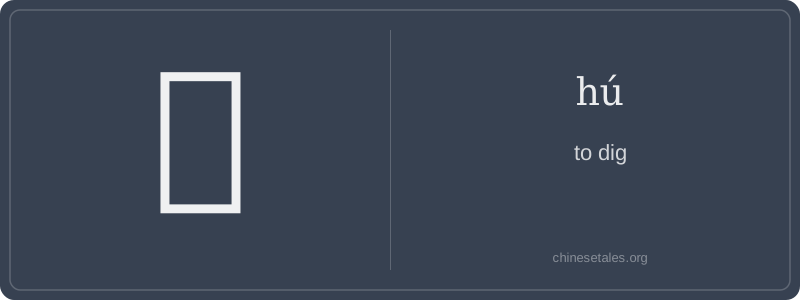
The earliest form of 搰 appears in Warring States bamboo slips, not oracle bones — and it’s a masterpiece of semantic engineering. The left side 扌 (hand radical) anchors human agency, while the right side 孤 (gū, 'orphan') isn’t phonetic coincidence: in ancient pronunciation, 孤 was near-homophonous with hú and visually echoed the act — its 'child + gu' structure suggested something small, exposed, and deeply rooted, like a seed buried deep. Over centuries, the right side simplified from 孤’s full form to its current stylized shape, retaining just enough visual weight to evoke both sound and the image of a hand driving downward into isolation.
This character first surfaced in the Zhuangzi (c. 3rd century BCE) describing the mythical sage who ‘digs wells without tools, his hands alone carving water from stone’ — a metaphor for effortless virtue. Later, in Tang poetry, 搰 described monks digging temple foundations at dawn, linking labor with spiritual discipline. Its visual form — hand + deep-rooted symbol — never strayed from its core: intentional, grounded, solitary effort. Even today, seeing 搰 on a page feels like hearing the muffled thud of a shovel hitting bedrock.
At its heart, 搰 (hú) is a visceral, earthy verb meaning 'to dig' — not the polite, metaphorical kind ('dig into a problem'), but the raw, physical act: shoveling soil, gouging clay, or burrowing deep with hands or tools. It carries grit and effort, often implying laborious, persistent excavation — think farmers breaking stubborn ground or archaeologists brushing dust from ancient bronzes. Unlike common verbs like 挖 (wā), which dominates modern speech and writing, 搰 is literary, archaic, and poetic; you’ll rarely hear it in daily conversation, but it thrives in classical texts, idioms, and formal rhetoric where weight and antiquity matter.
Grammatically, 搰 functions as a transitive verb, almost always taking a direct object (e.g., 搰土, 搰井). It rarely appears alone — you won’t say 'He dug' without specifying *what* was dug. Learners sometimes misplace it in casual contexts (e.g., saying ‘我搰地’ instead of ‘我挖地’), which sounds jarringly archaic or even comically over-dramatic — like quoting Zhuangzi while ordering takeout. Also, it’s never used for metaphorical digging (no 'digging for truth' here); that’s 挖 or 探.
Culturally, 搰 evokes agrarian endurance and Daoist humility — digging not to conquer land, but to commune with it. Its rarity makes it a linguistic fossil: when it appears, it signals deliberate stylistic choice — a nod to antiquity, moral gravity, or rustic authenticity. A common mistake is overestimating its frequency; it’s not 'just another word for dig' — it’s the *ceremonial spade*, not the garden trowel.