搌
Character Story & Explanation
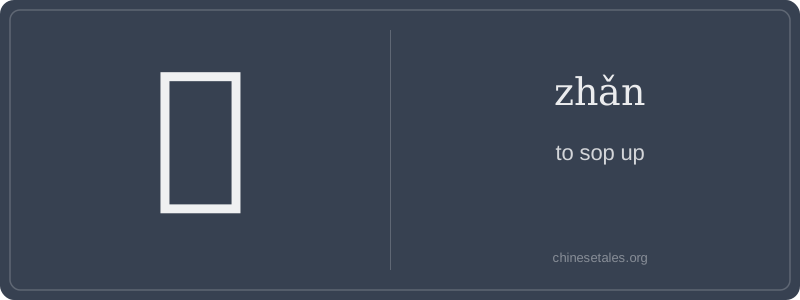
The earliest form of 搌 isn’t found in oracle bones, but emerges clearly in clerical script (lìshū) during the Han dynasty. Its left side 扌 (hand radical) was already standardized, while the right side 展 (zhǎn, ‘to unfold’) began as a pictograph combining 尸 (a crouching person) + (a bent arm) + 正 (uprightness) — evolving into today’s 展, meaning ‘to stretch out, unfold’. So visually, 搌 literally means ‘to hand-unfold’: imagine pressing a cloth flat and wide against a wet surface to maximize absorption — a gesture of deliberate, full-contact spreading.
This physical metaphor deepened in literary usage. In Ming dynasty vernacular fiction like *The Plum in the Golden Vase*, 搌 appears in domestic scenes where maids ‘搌净茶渍’ (sop clean tea stains) — emphasizing care, precision, and invisibility of labor. By Qing times, 展’s ‘unfolding’ sense fused with 扌’s agency to crystallize the modern meaning: not just wiping, but *absorbing by sustained, even pressure*. Interestingly, the character never appears in classical poetry or philosophy — it’s a workaday word born from household pragmatism, making its persistence over 400 years a quiet tribute to the dignity of domestic craft.
At its heart, 搌 (zhǎn) is the quiet, tactile act of soaking up liquid — not with a pump or a vacuum, but with soft, deliberate pressure: a cloth pressed firmly onto a spill, a sponge held still until it’s saturated. It’s not ‘wipe’ (擦 cā), which implies motion; nor ‘dry’ (晾 liàng), which implies air exposure. 搌 is absorption through contact and pause — a very Chinese sensibility that values quiet efficacy over showy action. You’ll hear it in kitchens, labs, and hospital rooms, always paired with a noun for the absorbent tool: 搌布 (zhǎn bù, 'sopping cloth'), 搌桌 (zhǎn zhuō, 'sop the table').
Grammatically, 搌 is almost always transitive and requires an object — you don’t just ‘zhǎn’; you zhǎn *something* *with something*. Learners often mistakenly use it like a general-purpose ‘clean’, leading to odd sentences like *‘我搌地板’* (I zhǎn the floor) — which sounds like you’re pressing a towel vertically into floorboards! Instead, it’s *‘用抹布搌干水渍’* (Use a rag to sop up the water stain). The verb also rarely appears alone in speech; it’s usually embedded in compound verbs or passive constructions like 被搌干净了 (was thoroughly sopped up).
Culturally, 搌 reflects a subtle reverence for material tactility — the way Chinese domestic wisdom treats cloth, moisture, and surface as a triad of interdependent forces. Older speakers may recall their mothers saying *‘搌轻点,别把漆蹭掉了’* (Sop gently — don’t rub off the lacquer!), revealing how 搌 implies controlled, non-abrasive removal. A common error? Confusing it with 掸 (dǎn, ‘to dust off’), which uses the same 扌 radical but involves light, flicking motions — the opposite energy.