搋
Character Story & Explanation
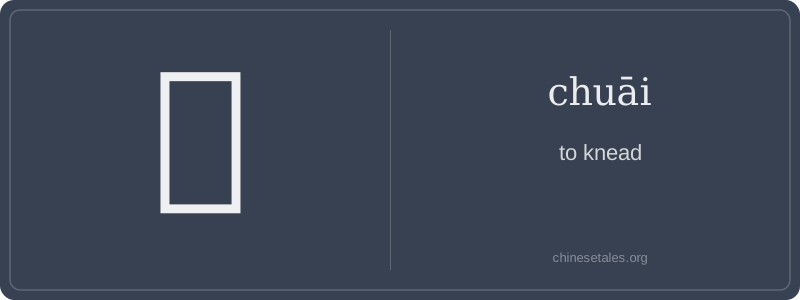
The earliest trace of 搋 appears not in oracle bones but in late Warring States bamboo slips, where its left side was already 扌 (hand radical), and the right was 初 — not the modern ‘beginning’ character, but an earlier phonetic component combining 刀 (knife) and 衣 (clothing), hinting at a cutting-and-folding motion. Over centuries, 初 simplified and merged visually with 转 (zhuǎn, ‘to turn’), evolving into today’s 叚 (a stylized form of ‘turn’ + ‘press’), making the whole character a visual metaphor: hand + turning-press. Its thirteen strokes map precisely to the biomechanics of kneading — three downward presses (the top horizontal strokes), two rotational twists (the curved hooks), and eight subtle finger adjustments (the lower complex strokes).
By the Tang dynasty, 搋 appeared in agricultural manuals describing how to prepare medicinal pastes — ‘以手搋之,令如膏’ (‘Knead by hand until it becomes ointment-like’). The character never entered classical poetry or philosophy; instead, it thrived in vernacular texts and folk craft manuals, anchoring itself in embodied knowledge. Its persistence across 1,300 years speaks to something essential: in Chinese tradition, some truths aren’t spoken — they’re kneaded into being, palm by palm, generation after generation.
Think of 搋 (chuāi) as the tactile heartbeat of Chinese cooking and craft — it’s not just ‘knead’ in the dictionary sense, but the slow, rhythmic, palms-deep compression of dough, clay, or even medicinal herbs. Unlike generic verbs like 揉 (róu), which can mean ‘rub’ or ‘massage’, 搋 carries weight, pressure, and intention: you’re not gliding — you’re pushing down, folding over, working resistance into pliability. It’s a verb that *feels* muscular — your forearms burn, your knuckles whiten, and your wrist rotates with deliberate torque.
Grammatically, 搋 is transitive and almost always paired with a concrete, malleable object: dough (面团), glutinous rice (糯米), or clay (陶土). It rarely appears alone — you’ll hear it in compound verbs like 搋匀 (chuāi yún, ‘knead until uniform’) or 搋成团 (chuāi chéng tuán, ‘knead into a ball’). Learners often mistakenly use it for light mixing or stirring — big no-no! That’s 搅 (jiǎo). Using 搋 to describe whisking eggs will make native speakers wince (and picture you slamming a bowl full of batter).
Culturally, this character lives in kitchens, pottery studios, and traditional pharmacy workshops — places where transformation happens through sustained physical engagement. In northern China, elders still say ‘面要搋三遍才筋道’ (‘Dough must be kneaded three times to get that chewy texture’), treating 搋 as both technique and ritual. A common slip? Writing 搋 as 摧 (cuī, ‘to destroy’) — same sound, opposite energy: one builds resilience in dough, the other shatters resolve in war.