揃
Character Story & Explanation
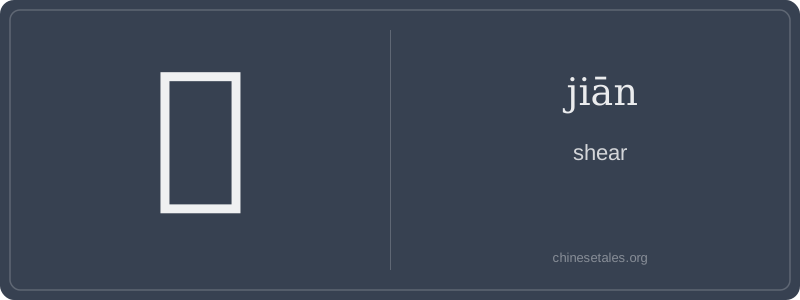
The earliest form of 揃 appears in seal script (zhuànshū), where it combines 手 (hand, radical 扌) on the left with 前 (qián, 'ahead') on the right—but crucially, the top of 前 originally depicted *two blades crossing*, not just ‘ahead’. In bronze inscriptions, this upper component resembled open shears poised over a line—visually echoing the sharp, converging motion of scissor blades. Over centuries, the right side simplified: the ‘knife’ elements fused into the modern 前 shape, while the hand radical solidified as 扌. Stroke count is 12—not zero—and the final form preserves that dynamic tension: hand + blade convergence = deliberate severing.
This visual logic shaped its meaning from the start: 揃 never meant ‘chop’ or ‘slash’—it specified *shearing with paired blades*. In the Shuōwén Jiězì (121 CE), Xu Shen defined it as ‘to cut evenly with scissors’, highlighting symmetry and control. Classical texts use it for pruning orchards (‘揃其繁枝’) or trimming ceremonial robes (‘揃衣边’). Unlike 剪, which entered vernacular early, 揃 remained literary—its form literally holding two blades in balance, a silent lesson in precision.
Imagine a master hairdresser in Kyoto’s Gion district—scissors glinting, fingers flying—not just cutting hair, but *deliberately shaping* it: trimming stray ends, thinning thick sections, sculpting a precise fringe. That’s 揃 (jiān): not generic ‘cut’, but *controlled, fine-scale shearing*—with scissors, clippers, or even specialized tools. It evokes precision, intention, and often, aesthetic refinement. You won’t hear it in casual speech like ‘I cut my nails’ (that’s 剪 jiǎn); 揃 appears in refined, technical, or literary contexts—hairstyling, textile finishing, or classical poetry describing clipped willow branches.
Grammatically, 揃 is almost always a verb, usually transitive and often paired with measure words like ‘几下’ (a few snips) or objects like ‘发’ (hair), ‘枝’ (branches), or ‘羽’ (feathers). It rarely stands alone; you’ll see it in compounds (e.g., 揃枝, 揃羽) or as the main verb in formal descriptions: ‘他细心地揃去枯叶’ (He carefully sheared off the dead leaves). Learners mistakenly substitute 剪 here—but 剪 implies broader cutting action, while 揃 conveys *removing small, unwanted portions to perfect a whole*.
Culturally, 揃 carries quiet elegance—it’s the character used in Japanese loanwords like ‘senba’ (scissors) and appears in Chinese poetic diction (e.g., Du Fu’s lines about trimmed bamboo). Modern Mandarin rarely uses it solo, so encountering it feels like spotting an antique tool in a modern workshop: rare, purpose-built, and deeply intentional. The biggest pitfall? Assuming it’s interchangeable with 剪 or 切—doing so strips away its nuance of *artful reduction*.