掾
Character Story & Explanation
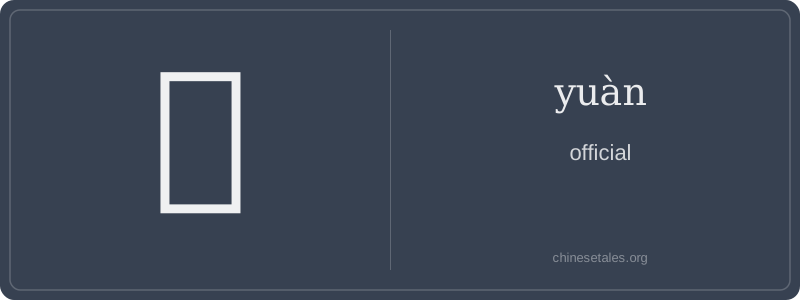
The earliest form of 掾 appears in Han dynasty clerical script — not oracle bone, but already highly stylized. Visually, it merges three key elements: the left-hand radical 扌 (hand), the central component 爰 (yuán, an ancient phonetic element meaning 'to draw forth' or 'to transfer'), and the bottom stroke group that evolved from 灬 (fire dots) into the modern four-dot base. Originally, 爰 depicted a hand pulling a rope attached to a ritual vessel — symbolizing the transfer of authority or documents. Over centuries, the rope morphed into the curved strokes above 灬, while the hand radical solidified on the left.
This visual logic shaped its meaning: a hand (*扌*) actively handling (*爰*) official business — thus 'clerk'. By the Eastern Han, 掾 was standard in titles like 尚書掾 (shàng shū yuàn, 'Clerk of the Secretariat'). Sima Qian used it in the Shǐ Jì to describe low-ranking yet indispensable functionaries. Its enduring image isn’t of robes and rank, but of ink-smeared fingers turning bamboo slips — a testament to how bureaucracy ran on quiet, skilled hands.
Think of 掾 not as a generic 'official' but as a *clerk* — the quiet, ink-stained backbone of imperial bureaucracy: the scribe who drafted documents, filed reports, and kept records for magistrates in Han dynasty yamens. Its core feel is administrative precision, not political power — it’s the person *handling* authority, not wielding it. You’ll almost never hear 掾 in modern spoken Chinese (hence its absence from HSK), but you’ll spot it in classical texts, historical novels, and formal titles like 掾吏 (yuàn lì) — where it carries a whiff of scholarly diligence and quiet competence.
Grammatically, 掾 functions exclusively as a noun, usually in compound words or titles — never alone in speech, and never as a verb or adjective. Learners sometimes mistakenly try to use it like 官 (guān, 'official') in phrases such as 'he is a yuàn', but that’s ungrammatical; instead, it appears only in fixed terms like 功曹掾 (gōng cáo yuàn, 'Director of Merit Affairs'). It also appears in surnames (e.g., Yùan family), adding another layer of archaic resonance.
Culturally, 掾 evokes the Confucian ideal of the literati-servant: educated, loyal, meticulous — a role immortalized in the Records of the Grand Historian and Tang poetry. A common mistake? Pronouncing it as 'yuán' (like 元) — but it’s firmly yuàn, with a falling tone, echoing the weight of responsibility it once carried. Its radical 扌 (hand) hints at action: *hands drafting, filing, sealing* — not just sitting in office.