掟
Character Story & Explanation
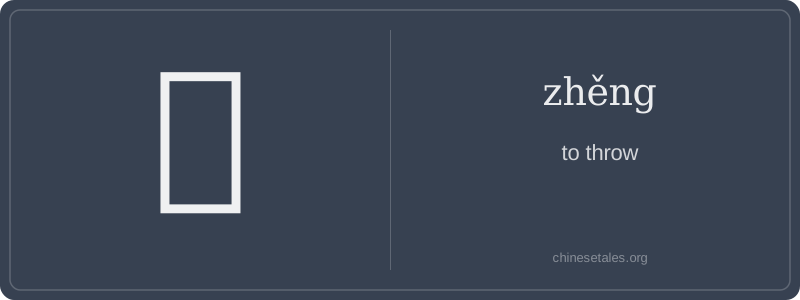
The earliest form of 掟 appears in late Warring States bamboo slips and Han dynasty seals — not oracle bones — and it’s a brilliant piece of semantic engineering. The left side 扌 (hand radical) is straightforward, but the right side 定 (dìng, 'to fix, settle') is the key: imagine a hand *fixing* an object in mid-air — then *releasing it decisively*. Over centuries, 定 simplified visually: its top 宀 (roof) and middle 立 (stand) merged into a compact, angular shape, while the bottom 乚 (hook) curved downward, giving 掟 its distinctive sharp, downward flick — like a wrist snapping forward to launch something.
This visual logic shaped its meaning: 掟 wasn’t about aim or distance (like 投), but about *finality* — the moment an object is detached from control and sent off with intention. In Tang dynasty poetry fragments and Ming-Qing vernacular novels, 掟 appears in furious domestic scenes: '掟箸而起' (fling down chopsticks and rise), signaling explosive indignation. Even today, that downward stroke feels like gravity taking over — not just motion, but *abandonment*.
Let’s be honest: 掟 (zhěng) is a linguistic ghost — it’s real, it’s in dictionaries, and native speakers *do* recognize it… but you’ll almost never hear it in daily speech or see it in modern texts. Its core meaning is ‘to throw’ — not gently tossing a ball, but a forceful, often abrupt, hurling action, like flinging something away in anger or haste. Think of it as the grumpy cousin of 扔 (rēng) or 投 (tóu), carrying extra weight of impatience or dismissal.
Grammatically, 掟 is a transitive verb, used like 把 + object + 掟 + result complement (e.g., 把碗掟到地上 — 'fling the bowl onto the ground'). It doesn’t take aspect particles (了, 过) easily, and you’ll rarely see it in formal writing — it’s mostly preserved in regional dialects (especially Minnan/Hokkien-influenced speech) and literary echoes. Learners who stumble upon it online might mistakenly use it like 扔, but native speakers will raise an eyebrow — it sounds archaic, theatrical, or even dialectal, like quoting an old opera.
Culturally, 掟 carries a whiff of Southern China and Taiwan — where it survives in colloquial verbs like 掟掉 (zhěng diào, 'chuck away') or in expressive slang ('掟你一拳' — 'I’ll punch you!'). A common mistake? Confusing it with the much more common 投 (tóu, 'to throw, to submit') or 拍 (pāi, 'to clap') due to visual similarity in handwriting. But 掟 isn’t just 'throw' — it’s *rejective* throwing: urgent, emotional, and unapologetically physical.