挜
Character Story & Explanation
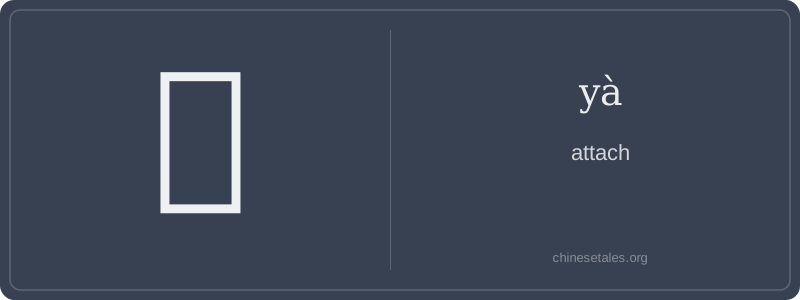
The earliest form of 挜 appears not in oracle bones but in late Ming vernacular texts and Qing-era dictionaries, where it emerges as a phono-semantic compound — no ancient pictograph. Its left-hand radical 扌 (hand) signals physical action; the right side 亚 (yà) provides both sound and subtle meaning: 亚 originally meant 'second rank' or 'subordinate', later acquiring connotations of 'imposition' — as in something placed *under* or *into* another’s domain without consent. Visually, the hand radical + 亚 creates a sense of 'hand placing something subordinate onto another' — a vivid stroke-by-stroke logic of unilateral transfer.
By the Qing dynasty, 挜 solidified in Beijing opera scripts and satirical fiction as a verb for socially clumsy attachment — like attaching an unwanted title ('Honorable Uncle') or tagging along uninvited. Lu Xun used variants of this semantic field to mock bureaucratic overreach, though he avoided 挜 itself. The character never entered classical literary usage, remaining a spoken-word rebel: born from mouth, not brush; shaped by attitude, not ritual. Its visual simplicity (just 9 strokes) belies its rich social texture — a reminder that in Chinese, the smallest characters sometimes carry the loudest interpersonal commentary.
Think of 挜 (yà) as Chinese linguistic duct tape — not the polite, measured 'attach' you’d use in a manual, but the insistent, slightly awkward, even pushy kind: forcing something onto someone who didn’t ask for it. In English, it’s closer to 'shove', 'foist', or 'tag on' — like when your aunt insists on slipping extra dumplings into your bag *after* you’ve said no three times. Its core vibe is volition + resistance: one party acts unilaterally, and the other is passive or unwilling.
Grammatically, 挜 is almost always transitive and often appears in colloquial or dialectal contexts (especially Northern Mandarin and Beijing speech), frequently paired with 把 (bǎ) constructions or verbs like 挜给 (yà gěi) — 'to force-give'. You won’t find it in formal reports or news headlines; it lives in lively dialogue, satire, or storytelling where attitude matters more than precision. A classic pattern: 挜 + [object] + 给 + [person], e.g., ‘他硬把这主意挜给我’ (He stubbornly foisted this idea onto me).
Culturally, 挜 carries gentle social friction — it hints at boundary-pushing without outright aggression. Learners often misapply it as a neutral synonym for 连接 (liánjiē, 'connect') or 粘 (zhān, 'stick'), but those lack its human drama. Worse: confusing it with 压 (yā, 'press down') — same sound, totally different intent. 挜 isn’t about weight or force; it’s about *unwanted agency*. It’s the character that shows up when politeness wears thin, and intention overflows into imposition.