掍
Character Story & Explanation
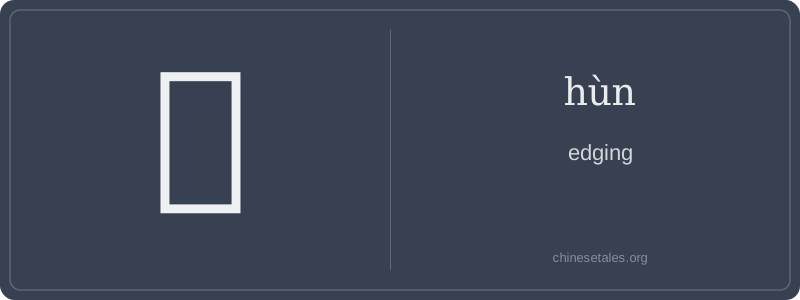
The earliest form of 掍 appears in late Warring States bamboo slips as a compound ideograph: left side was 糸 (sī, 'silk thread'), representing textile work, and right side was 昆 (kūn), a phonetic component also meaning 'together' or 'in succession'. Over time, the 糸 radical simplified to 纟, and 昆 lost its top horizontal stroke, becoming the modern 口+日 shape. Crucially, no oracle bone form exists — this is a Warring States-era coinage, born from the need to name a specific artisanal technique, not an ancient pictograph of nature or ritual.
By the Tang dynasty, 掍 solidified as a technical term in textile manuals like the Brocade Mirror Commentary, where it described the step of outlining floral motifs with contrasting thread before filling them in. Its meaning never broadened — unlike 混, which drifted from 'turbid water' to 'confuse', 掍 stayed rooted in the physical act of delineation. The character’s very structure — silk + 'together' — evokes thread laid down in tight, consecutive strokes along an edge, like a calligrapher drawing a firm, unbroken line. That discipline is baked into its bones.
Think of 掍 (hùn) not as a common word like 'mix' or 'confuse', but as the Chinese equivalent of the tailor’s chalk line — that faint, precise edge drawn along fabric before cutting. It doesn’t mean 'to mix' (that’s 混 hùn, with 氵); it means 'edging': the act of tracing, outlining, or defining a boundary — especially in textile, embroidery, or decorative craft contexts. It’s tactile, deliberate, and quietly meticulous.
Grammatically, 掍 is almost exclusively a verb, and nearly always appears in compound verbs like 掍边 (hùn biān, 'to edgestitch') or 掍花 (hùn huā, 'to outline a floral motif'). You won’t find it alone in modern speech — it’s a specialist’s term, used by artisans, pattern drafters, and classical textile manuals. Learners often misread it as 混 because of identical pronunciation and visual similarity, but mixing up 掍 and 混 is like confusing 'hemming' with 'blending' — one shapes the edge, the other dissolves it.
Culturally, 掍 carries the quiet prestige of pre-industrial craftsmanship: it appears in Qing-dynasty embroidery treatises and Ming tailoring manuals where precision at the margin was synonymous with virtue. Modern usage is rare — mostly in heritage crafts or regional dialects (e.g., Suzhou embroidery circles). A classic mistake? Assuming it’s interchangeable with 镶 (xiāng, 'to inlay') — but 掍 traces *only* the outer contour; 镶 adds material *alongside* it. That fine distinction is why this character survives — not in dictionaries, but in the hands of masters.