掊
Character Story & Explanation
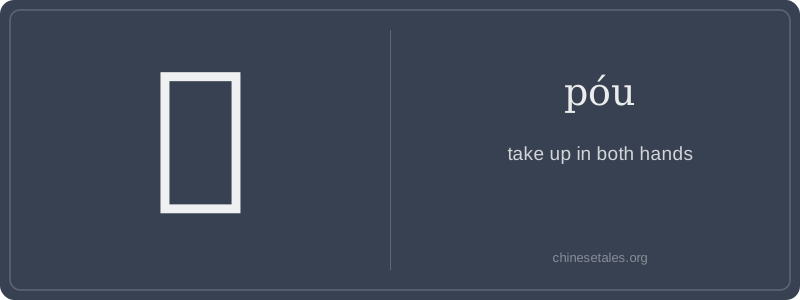
The earliest form of 掊 appears in bronze inscriptions as a hand () gripping a curved, mound-like shape — likely representing a clod of earth or a rounded scoop of grain. Over time, the hand radical 扌 standardized on the left, while the right side evolved from a pictograph of a bent arm holding a rounded mass into today’s 句 (jù), which here functions phonetically (its Middle Chinese pronunciation was close to *pəu*). The 11 strokes — five in 扌, six in 句 — subtly encode the motion: the three horizontal strokes in 句 mimic layered soil, and the hook at the end echoes the wrist’s upward curl as hands lift.
This character first appeared in Warring States bamboo texts describing ritual soil-gathering for tombs and altars. In the Classic of Rites, 掊土 (póu tǔ) meant ‘scooping sacred earth’ — a gesture linking human hands to cosmic order. Later, in Tang poetry, it gained metaphorical warmth: Du Fu wrote of 掊春泥 (póu chūn ní, ‘scooping spring mud’) to evoke nurturing life. Crucially, the visual logic holds: the hand radical + the curved, embracing shape of 句 = hands cupping and lifting — no abstraction, just embodied action frozen in ink.
At its heart, 掊 (póu) is a vivid, tactile verb: it means to scoop or lift something up with both hands — not just pick up, but *embrace* it upward, like cradling soil, grain, or water. It’s earthy and physical, evoking the weight, texture, and intention behind the motion. Unlike generic verbs like 拿 (ná, 'to take') or 捧 (pěng, 'to hold respectfully'), 掊 implies effort, full-hand contact, and often a downward-to-upward arc — think of gathering fallen leaves or hefting damp clay from a riverbank.
Grammatically, 掊 is almost always transitive and appears in literary or classical-influenced contexts — rarely in daily spoken Mandarin. You’ll see it in compounds (like 掊土 or 掊金), in poetic descriptions, or in idioms referencing excavation or acquisition. Learners sometimes mistakenly use it as a synonym for ‘steal’ (e.g., trying to say ‘pocket money’), but that’s dangerously off-target: 掊 carries no moral judgment — it’s neutral, even reverent when used in rituals (e.g., 掊土祭祖, scooping soil for ancestral rites). Its object must be tangible, granular, or malleable — you’d never 掊 a book or a phone.
Culturally, 掊 resonates with ancient agrarian sensibility: it’s the gesture of the farmer, the potter, the grave-digger, the ancestor-worshipper. Classical texts like the Zuo Zhuan use it in ceremonial contexts — ‘scooping earth to mound a tomb’ — reinforcing its solemn, grounded weight. A common mistake? Confusing it with 扒 (bā, ‘to dig/scratch’) or 抓 (zhuā, ‘to grab’): those are sharp, quick, finger-driven; 掊 is slow, full-palmed, and deliberate. Pronunciation note: while póu is standard for ‘scoop’, pǒu appears in rare dialectal or archaic usages — like in certain regional folk songs meaning ‘to pour out’ — but you’ll almost never need pǒu as a learner.