掇
Character Story & Explanation
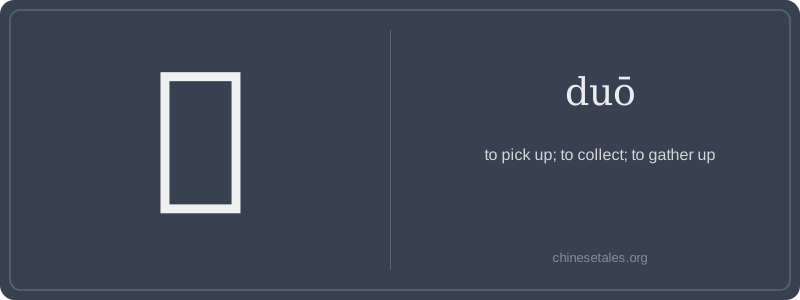
The earliest form of 掇 appears in bronze inscriptions as a hand (扌-like shape) reaching toward a stylized mouth or exclamation mark — not literally a mouth, but the ancient glyph 咄, which depicted a person speaking sharply or issuing a command. Over time, this evolved: the hand became the standardized 扌 radical, and 咄 solidified into its modern form — three strokes for the mouth (口), plus the 'dog' radical 犬 (now simplified to the dot-and-hook shape). By the Han dynasty, the character had settled into its current 11-stroke structure: 扌 + 咄 — a visual metaphor for 'hand acting with verbal precision'. The dots and hooks aren’t random; they echo the quick, decisive flick of fingers plucking something up at just the right moment.
This visual logic shaped its meaning: in the Classic of Poetry (Shījīng), 掇 appears in lines describing picking millet stalks — not harvesting en masse, but selecting sturdy ones. Later, in Tang poetry, it described scholars 'gathering' rare phrases like precious stones. Even today, 掇 retains that sense of discerning collection — whether it’s 掇取知识 ('gathering knowledge') or 掇菜 ('plucking vegetables') in farm narratives. Its persistence reveals how deeply Chinese writing ties physical gesture to intellectual care: to 掇 is to lift with both hands and mind.
Think of 掇 (duō) as the 'deliberate hand-pick' — not just grabbing, but selecting and lifting with intention, like gathering ripe plums one by one or scooping up scattered papers before they blow away. It’s tactile and precise: the left-hand radical 扌 (hand) anchors it in physical action, while the right side 咄 (duō) — originally a phonetic component that also evokes sharp, decisive sound — adds urgency and focus. Unlike generic verbs like 拿 (ná, 'to take') or 拾 (shí, 'to pick up off the ground'), 掇 implies conscious selection and upward motion: you *lift* something *up*, often from a surface or pile.
Grammatically, 掇 is mostly literary or formal — you’ll rarely hear it in casual speech, but it shines in written Chinese, classical allusions, and poetic descriptions. It can be transitive (direct object) or used in compound verbs like 掇拾 (duōshí, 'to gather up'). Watch out: learners sometimes overuse it trying to sound 'advanced', but native speakers reserve it for vivid imagery — e.g., 掇起一瓣落花 ('lifted up a fallen petal') sounds lyrical; 掇起我的手机 sounds oddly ceremonial! Also, it never takes aspect particles like 了 or 过 directly — instead, use 掇了起来 or 掇过.
Culturally, 掇 carries quiet dignity: in classical texts, it’s often linked to scholarly care — collecting fragments of wisdom, gathering fallen rites, or rescuing lost virtue. That’s why it appears in idioms like 掇菁撷华 (duō jīng xié huá, 'to gather the finest essence'), where it’s not about quantity, but curation. A common mistake? Confusing it with 掉 (diào, 'to drop') — same stroke count, opposite direction!