抡
Character Story & Explanation
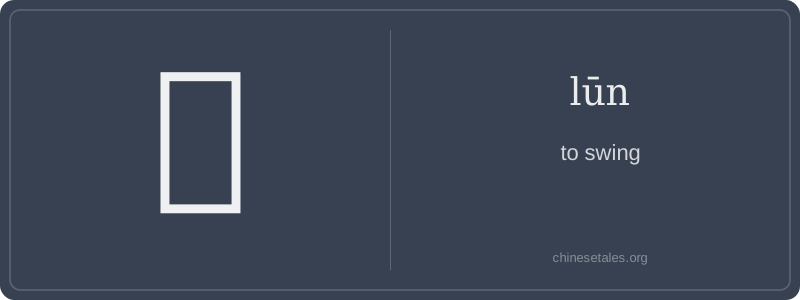
The earliest form of 抡 appears in seal script (c. 3rd century BCE), where it combined 扌 (hand radical) on the left with 仑 (lún) on the right — but crucially, 仑 itself evolved from an ancient pictograph resembling stacked bamboo slips or rotating gears, symbolizing *orderly rotation*. So visually, 抡 was literally 'hand + rotational order' — capturing the idea of a controlled, cyclical, purposeful arm movement. Over time, the right side simplified from 侖 (a more complex form with 'person' and 'wheel-like' elements) to 仑, while the hand radical solidified into 扌 — seven clean strokes that still echo the arc of a swinging limb.
This visual logic anchored its meaning across millennia: in the *Zuo Zhuan*, warriors 抡戟 (lūn jǐ, swing halberds); in Ming dynasty martial texts, masters taught how to 抡臂 (lūn bì, swing the arm) to generate qi flow; and today, 抡 retains that classical weight — it’s not just motion, but *ritualized kinetic precision*. Even the alternate reading lún (rare, found in literary compounds like 抡才, 'to select talent') preserves the 'rotational selection' nuance — as if talents are carefully spun through a sieve of merit.
Think of 抡 (lūn) as the Chinese character for *full-body, circular motion* — not just 'to swing' in a casual sense, but to wind up and unleash something with momentum: a fist, a hammer, a baseball bat, even a rhetorical flourish. It’s visceral and kinetic — you can almost hear the *whoosh* as the arm arcs. Unlike generic verbs like 摆 (bǎi, 'to wave') or 晃 (huàng, 'to sway'), 抡 implies force, intention, and a complete rotational sweep — often ending in impact or release.
Grammatically, it’s usually transitive and appears in compound verbs or action phrases: 抡起 (lūn qǐ, 'to lift and swing'), 抡圆 (lūn yuán, 'to swing in a full circle'), or 抡拳 (lūn quán, 'to throw a punch'). Watch out: learners often overuse it like English 'swing', but 抡 is rarely used alone — you’ll almost always see it paired (e.g., 抡起斧头, not just *抡斧头*). Also, avoid confusing it with 抢 (qiǎng, 'to snatch') — same hand radical, but wildly different meaning and sound.
Culturally, 抡 shows up in martial arts manuals, opera stage directions ('the hero 抡刀 leaps forward!'), and even modern slang like 抡大招 (lūn dà zhāo, 'to unleash a game-winning ultimate move'). Its energy feels distinctly *Chinese theatrical*: controlled power, dramatic timing, and physical poetry. A common mistake? Using it for gentle motions — 抡 is never for swinging a pendulum or a pocket watch!