掂
Character Story & Explanation
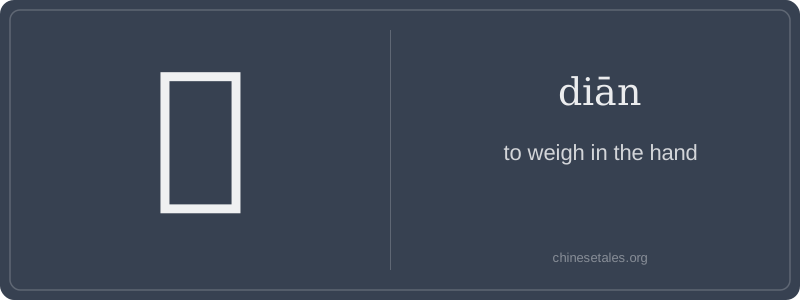
The earliest form of 掂 appears in seal script as 扌 (hand radical) + 占 (zhān, originally a pictograph of divination bones under a roof). But here’s the twist: 占 was borrowed for its sound (zhān ≈ diān in ancient pronunciation), while the hand radical anchored the meaning. Over time, 占 morphed visually—its upper '卜' (divination crack) simplified, and the lower '口' (mouth) stretched and tilted, becoming the modern 占 shape we see today. Stroke by stroke, the 11 strokes crystallized: three horizontal strokes for the hand’s movement (扌), then the flowing diagonal and hooks of 占—each stroke echoing the gentle up-and-down motion of hefting.
This character didn’t appear in oracle bones, but emerged strongly in Ming and Qing vernacular fiction, where merchants and connoisseurs ‘掂银子’ (diān yínzi) to test authenticity by weight and ring. The visual link is elegant: the hand radical (扌) does the action, while 占—though phonetic—subtly reinforces 'judgment' (as in 占卜, 'divination'). So 掂 is a rare hybrid: a 'hand + judgment' character where sound and meaning co-conspire. Even today, when you 掂 a package, you’re performing a tiny, ancient ritual of sensory discernment—less 'weighing', more 'asking the object a question.'
Imagine holding a ripe avocado in your palm—not to eat it, but to *gauge its readiness* by gently hefting it: that subtle up-down motion, the quiet assessment of weight and density, is exactly what 掂 (diān) captures. It’s not formal weighing on a scale (称 chēng), nor casual lifting (拿 ná)—it’s tactile judgment, a micro-gesture of evaluation rooted in physical intuition. In Chinese, 掂 almost always appears as a verb in serial verb constructions or as part of compound verbs like 掂量 (diānliang), and it rarely stands alone in speech.
Grammatically, 掂 is nearly always followed by an object and often paired with another verb: '掂一掂这个包' (diān yi diān zhè ge bāo)—'heft this bag once'—where the reduplication (掂一掂) signals a light, exploratory action. Learners mistakenly use it like 'to weigh' in abstract contexts ('I weigh my options'), but that’s 掂量; 掂 itself is stubbornly physical—you can’t 掂 a thought, only a melon, a suitcase, or a gold bar. Omitting the object or using it transitively without context sounds unnatural or even comical.
Culturally, 掂 reflects a deeply embodied Chinese sensibility: knowledge isn’t just observed—it’s *felt*. Merchants in old marketplaces would 掂 tea leaves or silver ingots to detect fakes; today, elders 掂 a watermelon to judge ripeness by vibration and resonance. Mistake it for a generic 'lift', and you’ll miss the nuance—it’s not about force, but finesse. And yes, native speakers still do this: quietly, deliberately, palms up—like a silent conversation between hand and object.