捽
Character Story & Explanation
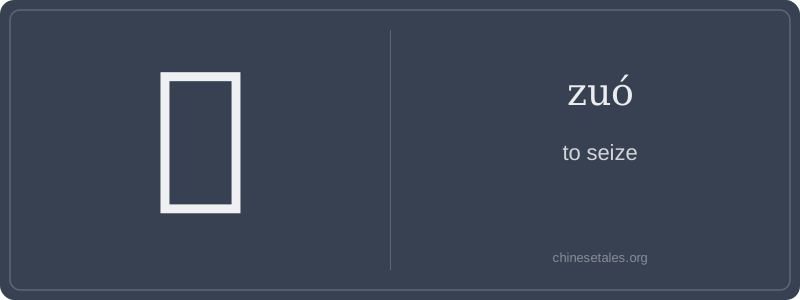
The earliest form of 捽 appears in bronze inscriptions as a composite pictograph: on the left, 扌 (hand radical), and on the right, a stylized depiction of a person with arms raised and sleeves flaring — suggesting an active, grasping motion toward a body. Over centuries, the right side simplified from a full human figure into the phonetic component 足 (zú, 'foot'), though this was purely sound-based (zuó and zú share historical phonetic kinship). The modern form retains 扌 + 足 — a visual echo of hands reaching down or locking onto limbs, not feet!
By the Han dynasty, 捽 had crystallized as a verb meaning 'to seize by the clothing or limb', appearing in legal texts describing arrests and in military manuals for close-combat holds. In the Shuōwén Jiězì (121 CE), Xu Shen defined it as 'to hold tightly, to grasp and restrain'. Its usage peaked in Ming-Qing vernacular fiction, where it added kinetic realism: 'He 捽住贼人衣领, 一跤掼倒' ('He seized the thief by the collar and slammed him down'). Though rare today, its visual logic — hand + 'foot' (suggesting grounding, control, or lower-body leverage) — still pulses with ancient bodily intelligence.
At its heart, 捽 (zuó) is a visceral, physical verb — not polite or abstract, but raw and immediate: to seize, grab, or wrestle someone by the collar, sleeve, or arm. Think of a martial artist’s sudden grip before a throw, or a parent yanking a child back from danger. It carries weight, urgency, and often a hint of confrontation — you wouldn’t 捽 your boss’s hand to greet them! Unlike gentler verbs like 拉 (lā, 'to pull') or 抓 (zhuā, 'to grab'), 捽 implies full-hand contact, deliberate force, and control over another person’s body.
Grammatically, 捽 is almost always transitive and requires a human (or at least animate) object — you 捽 someone, not something. It rarely appears in formal writing or modern spoken Mandarin; instead, it thrives in classical texts, regional dialects (especially Northern Mandarin), opera scripts, and vivid storytelling. Learners sometimes mistakenly use it like 抓 or 拿, but that breaks native intuition: you don’t 捽 a pen — you’d be gripping it like a weapon! Its tone (zuó, second tone) also trips people up — it rhymes with ‘duo’ in ‘duo’ (多), not ‘zuo’ (作).
Culturally, 捽 evokes theatricality and embodied conflict — think of Peking opera performers seizing each other mid-scene, or classical novels like Water Margin, where heroes 捽住歹徒 before delivering justice. Modern learners rarely need it for daily life, but recognizing it unlocks dramatic nuance in literature and film. A common mistake? Confusing it with 着 (zhe/zhuó/zháo) — visually distant but tonally similar. Remember: 捽 is hands-on, not abstract!