捻
Character Story & Explanation
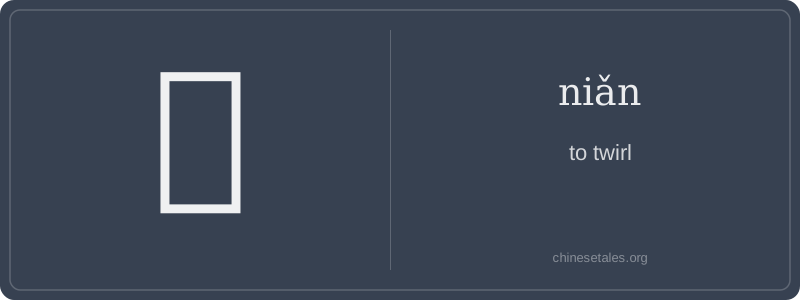
The earliest form of 捻 appears in seal script as a hand (扌) gripping two parallel, slightly curved lines — representing twisted fibers — with a small hook or knot at the end. Over time, the ‘two lines’ simplified into the ‘ren’ component (任) below: the top part (亻) evolved from a standing figure, while the bottom (壬) was originally a pictograph of a vertical pole with crossbars, symbolizing something being wound *around* a core. By clerical script, the hand radical stabilized on the left, and the right side crystallized into 任 — not because it means ‘to appoint’, but because its shape echoed the visual idea of controlled winding.
This visual logic shaped its semantic path: from literal fiber-twisting in Shang dynasty textile records, to figurative ‘manipulation’ in Han dynasty medical texts (e.g., 捻脉, ‘palpating the pulse’ with rotating finger pressure), to Ming-Qing vernacular fiction where villains ‘捻动权柄’ (twist the levers of power). Even today, when a Beijing opera actor ‘捻须’ (twirls his beard), he’s performing a centuries-old gesture encoded in this character’s very strokes — a silent grammar of dexterity.
At its heart, 捻 (niǎn) is the quiet, deliberate motion of twisting something slender between thumb and forefinger — think twisting a strand of silk, rolling a cigarette by hand, or coaxing a wick from cotton thread. It’s not a forceful grip or a broad gesture; it’s precise, tactile, intimate. The character feels almost *textural*: you can almost feel the friction in the stroke order — that quick downward flick of the final dot (丶) mimics the subtle snap of fibers aligning.
Grammatically, 捻 is primarily a transitive verb, often followed by an object (e.g., 捻线, 捻胡须). It rarely stands alone — you won’t say ‘I 捻’ without saying *what* you’re twirling. Learners sometimes misapply it as a general ‘twist’ (like turning a knob), but that’s 旋 (xuán) or 扭 (niǔ); 捻 implies fine motor control and material manipulation — always with fingers, always on something pliable and linear. In classical texts, it appears in craft descriptions (e.g., spinning thread) and poetic metaphors for delicate influence — like ‘捻动人心’ (gently stirring hearts).
Culturally, 捻 carries artisanal weight: it’s the verb of weavers, calligraphers adjusting brush tips, elders twisting tobacco, even surgeons manipulating sutures. A common mistake is overusing it for any rotational motion — but if your action doesn’t involve fingertips, tension, and thin matter, it’s probably not 捻. Also, watch tone: niǎn (third tone) is easily confused with niān (‘to pick up gently’) — same radical, different top, totally different meaning.