捙
Character Story & Explanation
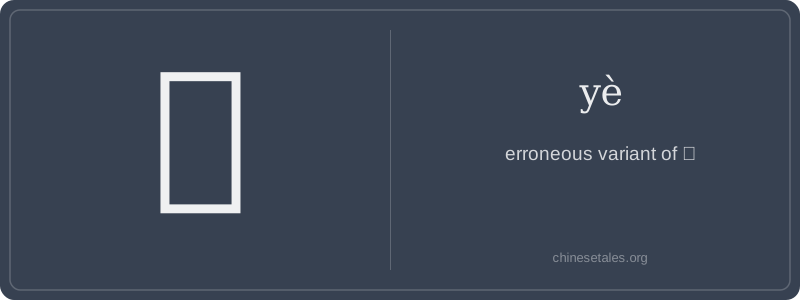
The character 捙 has no genuine ancient pedigree — it doesn’t appear in oracle bone inscriptions, bronze scripts, or even early seal forms. Its ‘origin’ is purely modern and accidental: a miswriting of 拽 during rapid cursive handwriting. Visually, 拽 combines 扌 (hand radical) with 曳 (yè, ‘to drag’), where 曳 itself evolved from a bronze script pictograph of a person pulling a rope tied to a heavy object. Over centuries, 曳 simplified — its upper part (‘one person + rope’) became the top of 曳, then got miswritten as 世 (shì) by scribes rushing to finish contracts or street signs. Thus, 捙 emerged: 扌 + 世 — a visual glitch masquerading as structure.
This ‘character’ gained fleeting traction in mid-20th-century handwritten notices, factory wall posters, and informal letters — especially in northern China — where people conflated 曳’s pronunciation (yè) with the shape of 世. But classical texts never used it; no rhyme dictionary lists it; even the Kangxi Dictionary ignores it. Its entire semantic life is parasitic — borrowing meaning, sound, and syntax from 拽 while contributing nothing original. In that sense, 捙 is a linguistic meme centuries before the internet: a copy-paste error that briefly went viral, then faded into orthographic limbo.
Here’s the truth no textbook will tell you: 捙 doesn’t really exist — at least, not officially. It’s a ghost character: a handwritten slip-up of 拽 (zhuāi/yè), born from hurried brushstrokes and regional scribbling. In Chinese, meaning isn’t just about dictionary definitions — it’s about orthographic authority. When a character appears in dictionaries like the Xiàndài Hànyǔ Cídiǎn only as ‘a mistaken form of 拽’, it reveals how deeply Chinese values precision, standardization, and institutional validation — a single stroke out of place can demote a glyph from ‘real’ to ‘regrettable typo’.
Grammatically, 捙 behaves exactly like 拽: it’s a colloquial verb meaning ‘to yank’, ‘to drag’, or (in northern dialects) ‘to act tough’. But here’s the kicker — you’ll almost never see 捙 in print, formal speech, or digital input. Typing it on most keyboards yields 拽 instead; OCR systems reject it. If you use 捙 in writing, native readers won’t misunderstand — they’ll pause, squint, and gently correct you. That’s not pedantry; it’s linguistic gatekeeping rooted in centuries of script reform.
Learners often stumble by memorizing 捙 as a ‘variant’ and then overusing it — a classic case of mistaking a fossilized error for a living alternative. The real cultural insight? Chinese doesn’t tolerate ‘harmless variants’ the way English tolerates ‘color/colour’. Here, orthography is moral infrastructure: one right way, many wrong ways — and 捙 sits firmly in the latter camp.