捘
Character Story & Explanation
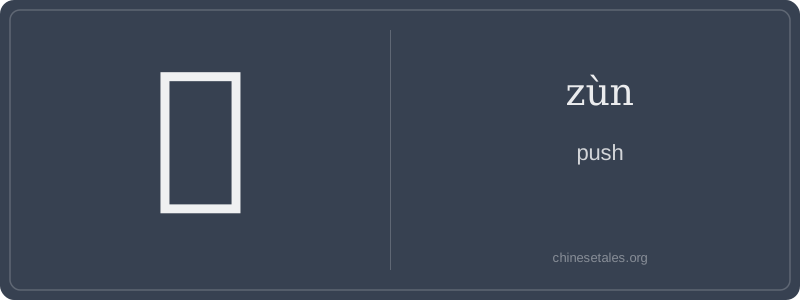
The earliest form of 捘 appears on Warring States bamboo slips (c. 475–221 BCE) as a composite ideograph: the left side was 扌 (hand radical), and the right side was 旬 — not as a phonetic, but as a stylized depiction of a hand gripping and rotating a cylindrical object (like a pestle or lever). Over centuries, 旬 simplified into 夋, losing its ‘ten-day cycle’ meaning entirely and becoming a purely visual placeholder for ‘controlled, rotational pushing force’. By the Han dynasty, the character stabilized into its current shape: 扌 + 夋 — a hand applying torque-driven pressure.
This visual logic shaped its semantic journey: 捘 never meant gentle ‘pushing’ like 推, but rather *resisted*, *mechanical*, or *leveraged* propulsion — think pushing against inertia or compressing something dense. In the 3rd-century text *Guangya*, it’s glossed as ‘to press down heavily’; in Tang dynasty poetry, it appears in lines describing warriors ‘pushing down banners’ (捘旗) — not waving, but forcibly lowering them in surrender. Its strokes aren’t arbitrary: the final stroke of 夋 curls like a finger hooking under something heavy — a silent instruction in biomechanics.
Let’s be honest: 捘 (zùn) is a linguistic ghost — it’s real, it’s in the dictionary, and it means 'to push', but you’ll almost never hear it spoken in modern Mandarin. Its core meaning is physical pressure applied forward or downward, like pressing a lever or shoving something stubborn. But here’s the kicker: it’s functionally obsolete as a standalone verb in speech. Native speakers use 推 (tuī), 挤 (jǐ), or 压 (yā) instead. 捘 survives only in highly literary, archaic, or dialectal contexts — think classical poetry, regional opera scripts, or historical novels where authors want that gritty, visceral weight of ‘forceful propulsion’.
Grammatically, 捘 behaves like a transitive verb (e.g., 捘门 ‘push the door’), but it *never* takes aspect particles like 了 or 过 — its usage is frozen in time. Learners who try to say ‘I pushed the box’ as 我捘了箱子 will raise eyebrows, not comprehension. It also appears in fixed compound verbs like 捘压 (zùn yā), where it intensifies the sense of oppressive pressure — not just ‘press’, but ‘press down with authority or resistance’.
Culturally, 捘 carries an almost tactile roughness: it evokes woodblock printing presses, stone millstones grinding grain, or a carpenter driving a chisel into stubborn timber. That’s why it’s absent from HSK — it’s not about frequency, but fossilization. Mistake it for 推 or 挤, and you’ll sound like someone quoting a Song dynasty stele at a Starbucks. Respect its antiquity — don’t force it into conversation; let it live beautifully in texts.