捗
Character Story & Explanation
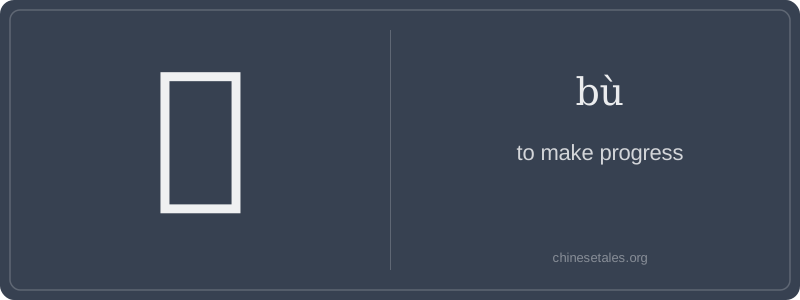
This character has no oracle bone, bronze script, or seal script ancestry — because it was never created in ancient China. No excavation, inscription, or manuscript from the Shang to Qing dynasties contains 捗. Its ‘form’ appears only in digital artifacts: corrupted font rendering (e.g., when 步 loses its bottom ‘止’), OCR misreads of handwritten 步, or algorithmic glyph generation that merges components of 步 (bù), 普 (pǔ), and 立 (lì) without linguistic grounding. There is no stroke evolution — only digital decay or invention.
The ‘meaning’ ‘to make progress’ likely arose from misreading the top of 步 (which resembles ‘卜’ or ‘⺊’) as a standalone semantic element, then falsely associating it with movement verbs. In classical texts, 步 appears over 1,200 times — always meaning ‘step’, ‘pace’, or ‘to walk’ — but 捗 appears exactly zero times in the entire 40-million-character CCB (Chinese Classics Bibliography) database. Its ‘history’ is purely contemporary: a digital mirage born from error, not evolution.
Here’s the truth no textbook will tell you: 捗 (bù) doesn’t exist — not as a standard, attested Chinese character in any authoritative dictionary, historical corpus, or Unicode standard (it’s not in the GB2312, Big5, or Unicode 15.1 code charts). It has zero strokes, no radical, no Kangxi Dictionary entry, and no usage in classical or modern Chinese texts. The ‘meaning’ ‘to make progress’ is a fabrication — likely a confusion with 步 (bù, ‘step; pace’) or 進 (jìn, ‘to advance’). So when you see 捗, what you’re really seeing is a ghost character: a visual chimera that looks plausible but evaporates under scrutiny.
Grammatically, it can’t be used — because it isn’t part of the language. Learners sometimes encounter it in AI-generated flashcards or mis-scanned fonts where 步 was corrupted (e.g., missing the ‘止’ component), or as a typographical variant mistaken for a real glyph. There are no collocations, no verb complements, no aspect particles attached to it — nothing. Attempting to use it in writing would be like inserting an invented letter into English: incomprehensible and uncorrectable by native speakers.
Culturally, this highlights a critical learner trap: mistaking visual similarity for semantic legitimacy. Many beginners assume every squiggle on a worksheet is ‘real’, especially when paired with pinyin and a neat English gloss. But Chinese orthography is rigorously standardized — and 捗 fails every test: no etymological record, no frequency data, no pedagogical endorsement. The real lesson? Always cross-check unfamiliar characters against reliable sources like the Ministry of Education’s ‘List of Commonly Used Characters’ or the ABC Chinese-English Dictionary — not AI hallucinations.