挓
Character Story & Explanation
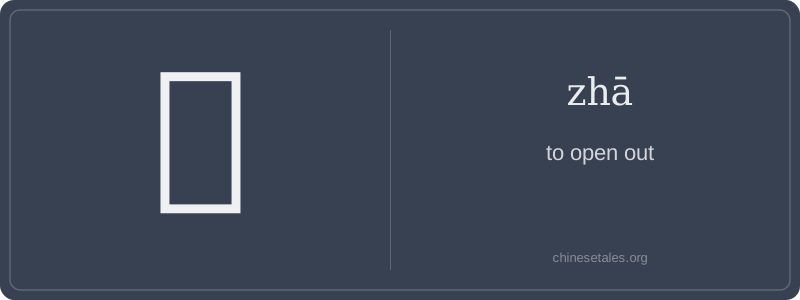
The earliest trace of 挓 isn’t in oracle bones — it’s a latecomer, born during the Northern and Southern Dynasties (420–589 CE) as a phonosemantic compound. Its left side 扌 (hand radical) signals bodily action; its right side 咱 (zán, originally a colloquial pronoun meaning ‘we’) was borrowed purely for sound — a clever phonetic loan. Over centuries, 咱 simplified visually and merged with 扌 into today’s compact form: three strokes on the left (representing hand movement), and a stylized, angular ‘咱’ reduced to two diagonal strokes and a dot — mimicking the sharp, outward splay of fingers.
This character didn’t exist in Confucian classics or Tang poetry — it emerged from spoken northern Mandarin, where vivid verbs thrived. By the Ming-Qing vernacular novels, 挓 (often as 挓挲) described animals bristling or people flinching in alarm. In Water Margin, a guard is described as ‘挓挲着眉毛,瞪眼而立’ — eyebrows flared upward, eyes wide — capturing that instant of visceral, unguarded reaction. The shape itself echoes this: no curves, only sharp angles pushing outward — a visual shout of expansion.
Let’s be honest: 挓 (zhā) is a quiet rebel — it’s not in the HSK, rarely appears in textbooks, and yet it carries a wonderfully tactile, almost physical sense of expansion. Think less 'open' like a door (开 kāi), and more 'spread wide', 'fan out', or 'push open against resistance' — like unfolding stiff origami, or flaring your fingers to test wind direction. It’s deeply kinesthetic: you feel this word in your palms and shoulders.
Grammatically, 挓 is almost always used as a verb in literary or regional contexts, often reduplicated (挓挲) for emphasis, and frequently paired with body parts: 挓挲着手 (zhā shā zhe shǒu) — 'spreading one’s hands wide while gesturing'; or 挓挲着耳朵 (zhā shā zhe ěr duo) — 'perking up one’s ears'. It’s never used transitively with objects like books or doors; you don’t ‘挓挲 a book’. That’s a classic learner trap — confusing it with 开 or 展.
Culturally, 挓 shows up most vividly in northern dialects and classical-influenced prose to convey alertness, agitation, or raw, unrefined energy — think a startled fox, a defiant child, or a rooster puffing its neck feathers. Learners often misread it as a variant of 扎 (zhā/zā) due to the shared sound and radical, but 扎 implies piercing or anchoring, while 挓 is all about outward radiance. Its rarity makes it a delightful ‘easter egg’ — once you spot it, you’ll start hearing its rustle in folk songs and rural dialogue.