挐
Character Story & Explanation
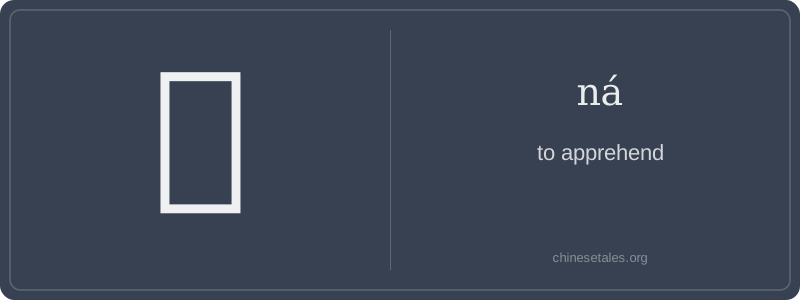
The earliest form of 挐 appears in Warring States bamboo slips—not as a pictograph, but as a highly stylized compound: the left side is 手 (hand radical, later simplified to 扌), while the right side is 奴 (nú, ‘slave’), originally depicting a woman with bound hands. Over centuries, the ‘slave’ component morphed visually: the top stroke became a dot, the horizontal strokes compressed, and the lower ‘female’ element (女) was gradually abstracted into the modern 又-like shape. Crucially, this wasn’t just ‘hand + slave’ as a literal image—it was a semantic-phonetic compound where 奴 provided both sound (nú → ná, via tone shift and phonetic borrowing) and moral weight: to apprehend was to assert rightful control over transgression.
By the Han dynasty, 挐 appeared in legal texts like the *Fengsu Tongyi*, used specifically for state-sanctioned seizure—of illicit goods, fugitives, or evidence. In Du Fu’s poetry, it surfaces in lines like ‘挐舟破浪’ (seizing the boat, cleaving the waves), where it evokes deliberate, forceful agency against chaos. The character never entered vernacular use; its visual complexity and narrow semantic range kept it confined to elite discourse—making it one of Chinese writing’s quietest, most authoritative ghosts.
Imagine a Tang dynasty magistrate in a dusty county yamen, slamming his wooden clapper down—not to declare judgment, but to order the immediate seizure of a corrupt grain merchant caught red-handed hoarding rice during famine. That decisive, authoritative act of 'laying hands on' someone or something to take control is the visceral heart of 挐 (ná). It’s not gentle ‘taking’ like 拿 (ná)—which is everyday, neutral, and colloquial—but a formal, often legal or literary act of apprehension: arresting, seizing, confiscating, or laying hold with intent and power.
Grammatically, 挐 appears almost exclusively in classical or literary contexts—never in modern spoken Mandarin or HSK vocabulary. You’ll find it in historical novels, legal edicts, or poetic lines like ‘挐云手’ (a martial arts term meaning ‘cloud-seizing hand’), where it conveys mastery and dominance. Learners sometimes mistakenly substitute it for 拿 because they share pronunciation and both involve ‘grasping’, but that swap would make a sentence sound archaic, jarring, or even nonsensical—like using ‘hath’ instead of ‘has’ in casual English.
Culturally, 挐 carries the weight of imperial authority and moral urgency. Its rarity today makes it a linguistic time capsule: when you encounter it, you’re stepping into a world of ritualized justice, Confucian rectitude, and classical precision. Misusing it won’t break communication—but it will instantly mark your Chinese as either deeply scholarly or charmingly anachronistic.