挌
Character Story & Explanation
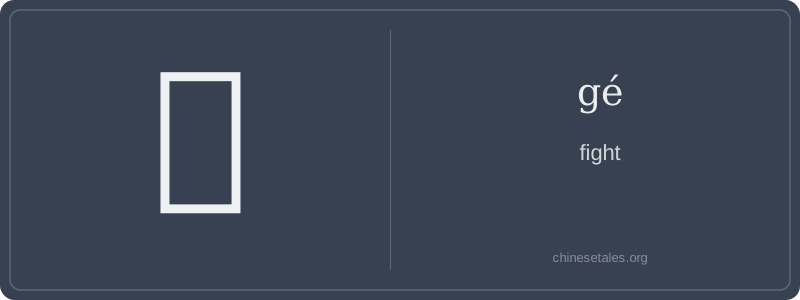
The earliest form of 挌 appears in Warring States bamboo slips — not oracle bones, but close enough in spirit. It depicts two hands (手) facing each other, fingers bent inward, gripping tightly, with a central vertical stroke suggesting tension or a dividing line — like two wrestlers’ arms interlocked at the wrists. Over centuries, the dual-hand motif simplified: the left side became the full 手 radical (not the shorthand 扌), while the right side evolved into 各 (gè), originally meaning 'each' or 'individually', but here repurposed phonetically (gé) and semantically to imply 'mutual, reciprocal action'. By the Han dynasty clerical script, the shape stabilized into today’s form: 手 + 各 — literally 'hand meeting hand'.
This visual logic deepened its meaning: 挌 wasn’t just fighting — it was *reciprocal physical engagement*. In the Mencius (3B:9), it appears in the phrase '挌於市' (gé yú shì), describing a public wrestling match used metaphorically for moral struggle. Later, in Ming dynasty martial manuals like Jiào Dì Jīng, 挌 became synonymous with bare-handed contesting — distinct from swordplay or archery. Its persistence reflects how Chinese writing preserves embodied knowledge: this character doesn’t describe violence — it encodes the physics of grip, balance, and resistance in six strokes.
Let’s be honest: 挌 (gé) is a rare, almost rebellious character — it’s not in the HSK, rarely appears in modern textbooks, and yet it pulses with raw, visceral energy. Its core meaning isn’t just 'fight' in the abstract sense; it’s *hand-to-hand combat*, grappling, wrestling — two people locked in physical struggle, limbs entangled, no weapons, just pure bodily resistance. Think sumo meets street scuffle. That’s why it carries a grittier, more immediate feel than common synonyms like 打 (dǎ, 'hit') or 斗 (dòu, 'contend').
Grammatically, 挌 functions almost exclusively as a verb — but crucially, it’s nearly always used in compound verbs or literary set phrases, never alone in casual speech. You won’t say '我挌' — you’ll say 挌斗 (gé dòu, 'grapple-and-fight') or 挌杀 (gé shā, 'wrestle to death', archaic). It also appears in classical idioms like 挌臂而谈 (gé bì ér tán, 'to clasp arms while talking' — implying fierce, passionate debate). Learners often mistakenly treat it like a standalone action verb; in reality, it’s a fossilized lexical root — elegant, potent, but grammatically shy.
Culturally, 挌 echoes ancient martial traditions where hand-wrestling (jiǎo dì, later jǐu dì) was both sport and ritual — recorded as early as the Zhou dynasty. Modern learners sometimes confuse it with 更 (gēng, 'more') due to similar pronunciation, or misread its radical as 扌 when it’s actually 手 (shǒu) — a subtle but important distinction: 手 is the full 'hand' radical (used in formal/classical contexts), not the abbreviated 扌. This tells you 挌 belongs to the world of classical texts and martial classics, not WeChat chats.