挈
Character Story & Explanation
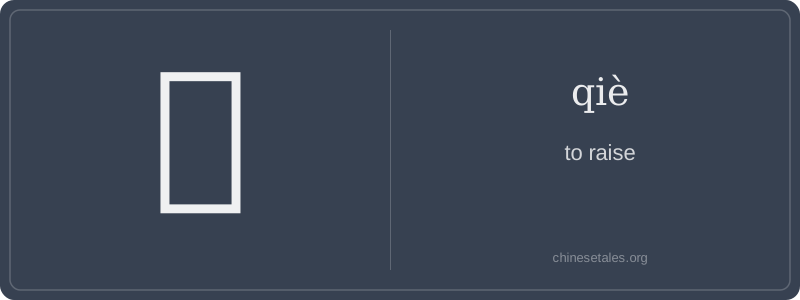
The earliest form of 挈 appears on Warring States bamboo slips as a vivid pictograph: a hand (, precursor to 扌) gripping the top edge of a woven basket or sack — shown with clear horizontal straps. Over centuries, the basket simplified into the right-hand component — the top part evolved into 丰 (fēng, originally depicting abundant grain stalks), while the lower part became 刀 (dāo, 'knife') — but wait! That ‘knife’ is actually a stylized rendering of the basket’s sturdy handle or binding cord, misread over time. The modern 10-stroke shape crystallized in the Han dynasty clerical script: 扌 (hand radical) + 丰 (abundance) + 刀 (here, not knife but a firm grip — like clamping down on a strap).
This visual origin explains everything: 挈 wasn’t about cutting or harvesting — it was about *lifting a full container with both hands*, requiring strength, balance, and care. By the Tang dynasty, poets used it metaphorically: Bai Juyi wrote of 挈壶 (qiè hú, 'lifting the wine vessel') — not just pouring, but ceremonially raising it in toast. Later, in Neo-Confucian texts, 挈 acquired moral gravity: to 挈纲 (qiè gāng) — 'lift the main rope of a net' — meant to grasp the central principle and thereby organize all lesser matters. Its stroke count (10) even echoes the 'ten directions' — symbolizing comprehensive, intentional uplift.
Think of 挈 (qiè) not as a bland 'to raise' but as the precise, slightly formal act of lifting something *upward and outward* — often with care, intention, or even moral weight. It’s not casual like 拿 (ná, 'to take') or mechanical like 举 (jǔ, 'to lift up'). Instead, 挈 evokes an image of someone grasping firmly — perhaps a teacher lifting a student’s hand to guide them, or a leader raising a banner to rally others. You’ll almost never hear it in everyday speech; it lives in classical idioms, literary prose, and formal set phrases.
Grammatically, 挈 is nearly always transitive and appears in compound verbs or fixed expressions — rarely alone. It pairs tightly with objects that carry symbolic weight: 挈领 (qiè lǐng, 'to grasp the collar' → 'to lead by the hand'), 挈眷 (qiè juàn, 'to lift one’s family' → 'to bring one’s family along'). Notice how the object isn’t just lifted — it’s *guided*, *brought along*, *taken under one’s charge*. Learners mistakenly try to use it like 抓 (zhuā, 'to grab') or 拿 (ná), but 挈 implies purposeful, upward-directed agency — no sudden grabs, no passive holding.
Culturally, this character breathes with Confucian resonance: it’s the verb of mentorship, stewardship, and principled leadership. In the Mencius, rulers are urged to 挈民 (qiè mín) — 'lift up the people' — meaning to elevate their virtue and welfare, not merely govern them. A common learner trap? Misreading its radical 手 (hand) as indicating physical force alone — when in fact, 挈’s power lies in its *directional intention*: upward + outward + responsible. Also, don’t confuse its pronunciation — qiè rhymes with 'yacht', not 'cheetah'!