拷
Character Story & Explanation
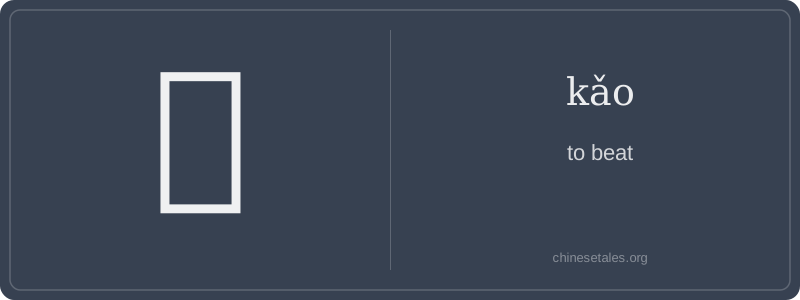
The earliest form of 拷 appears in seal script (c. 3rd century BCE), where it combined the hand radical 扌 (shǒu, indicating action) with 考 (kǎo, 'to examine, test') — itself originally a pictograph of an elder with bent back and long hair, symbolizing age and scrutiny. In bronze inscriptions, 考 sometimes included a kneeling figure beneath a hand-like stroke, subtly suggesting enforcement. Over centuries, the right side standardized into the modern 考 (7 strokes), while the left remained 扌 — resulting in today’s 9-stroke structure: three horizontal strokes for the hand, then six more forming 考’s distinctive arch and crossbars.
This visual fusion — 'hand' + 'examination' — perfectly encoded its meaning: physical coercion *as a method of verification*. By the Han dynasty, 拷 was entrenched in legal texts like the *Fajing* (Book of Law), describing sanctioned torture during criminal investigation. Confucian scholars like Dong Zhongshu criticized its overuse, calling it a 'violation of benevolence' — yet it persisted for millennia. The character’s shape still whispers that ancient logic: truth, they believed, could be *wrestled* from the flesh. No wonder modern Chinese uses it only to condemn — not to justify.
At its core, 拷 (kǎo) isn’t just ‘to beat’ — it’s specifically *to beat someone into confessing*, or to subject someone to coercive interrogation. It carries a visceral, almost theatrical weight: think ropes, dim rooms, and the crack of a bamboo stick — not casual violence, but institutionalized pressure. Unlike generic verbs like 打 (dǎ, 'to hit'), 拷 is nearly always transitive and morally charged; you 拷 someone *for information*, never just 拷 the table or 拷 your coffee cup. It’s rare in polite speech and absent from daily conversation — you’ll encounter it mostly in historical dramas, legal texts, or critical discussions about justice.
Grammatically, it appears in tight verb–object structures like 拷打 (kǎo dǎ, 'to torture by beating') or as part of compound verbs like 拷问 (kǎo wèn, 'to interrogate under duress'). Note: it doesn’t take aspect particles easily — you won’t say 拷了 or 拷过 casually; instead, context often implies past action via time words (e.g., 明朝时曾拷过他). Learners mistakenly use it like 打, leading to jarring sentences like *我昨天拷了我的朋友* — which sounds like you tortured your friend for a confession, not playfully tapped them on the shoulder.
Culturally, 拷 is a linguistic fossil of imperial justice — where truth was believed to reside in the body’s pain response. Its near-absence from modern spoken Chinese reflects how deeply China’s legal consciousness has shifted: today, 拷 is used almost exclusively to critique abuse of power or evoke historical injustice, never to describe legitimate procedure. That subtle moral gravity is what makes it unforgettable — and why it’s wisely omitted from beginner lists like HSK.