扼
Character Story & Explanation
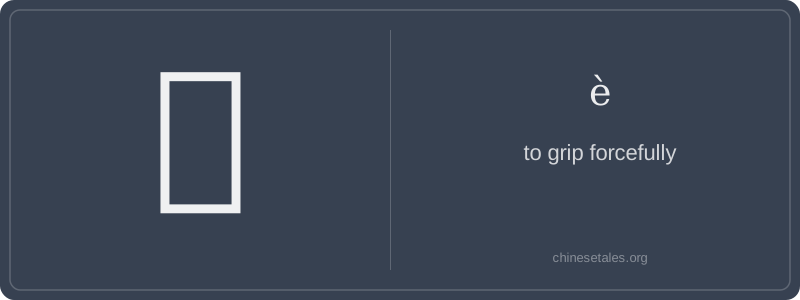
The earliest form of 扼 appears in bronze inscriptions as a hand (, precursor to 扌) gripping a stylized neck or throat — often drawn as a vertical line with two small curves representing collarbones or tracheal cartilage. Over time, the neck element simplified into the '厄' component (è), which itself originally depicted a person trapped under a roof — symbolizing confinement. By the seal script era, the hand radical firmly anchored the left side, while the right side crystallized into 厄, preserving both the physical act and the idea of constriction. The seven strokes we write today are a streamlined, elegant distillation of that ancient gesture: three strokes for the hand, four for the trapped throat.
This visual logic directly shaped its semantic evolution. In the Zuo Zhuan, 扼 appears in battle reports describing generals who '扼其隘' — 'gripped their narrow pass', i.e., seized and controlled a chokepoint. Later, in Tang dynasty poetry and Ming-Qing novels, 扼 began extending metaphorically: 扼腕 ('grip one’s wrist') expressed frustrated sorrow; 扼要 ('grip the essentials') meant 'to concisely capture the crux'. Even today, the character refuses abstraction without grounding in physicality — every metaphor still echoes that original hand-on-throat image.
Think of 扼 (è) as the Chinese verb for 'to grip with intent' — not just holding, but gripping *to control*, *to suppress*, or even *to strangle*. It’s visceral, physical, and often metaphorical: you don’t just ‘hold’ a situation — you 扼住 its throat. Unlike generic verbs like 抓 (zhuā, 'to grab') or 拿 (ná, 'to take'), 扼 implies deliberate, forceful constraint — like seizing a lever to stop motion, or clamping down on dissent before it spreads.
Grammatically, 扼 is almost always used in the compound 扼住 (è zhù), meaning 'to grip tightly at (a point)' — usually followed by a body part (喉, 'throat') or an abstract noun (要, 'crucial point'). It rarely stands alone. Learners often mistakenly use it like 抓 or 捏, but 扼 carries no casual or playful connotation — it’s serious, strategic, and slightly ominous. You’d never say '扼住我的手' ('grip my hand'); that’s unnatural and sounds violent. Instead, you’d say 扼住咽喉 ('grip the throat') — literally or figuratively.
Culturally, this character appears frequently in political, military, and literary discourse — think of classical texts describing how a general 扼守险要 ('controls a strategic pass') or modern essays warning against policies that 扼杀创新 ('strangle innovation'). A common learner trap? Confusing it with 易 (yì, 'easy') due to similar top shapes — but remember: 扼 has the hand radical (扌), so it’s always about *action*, not ease. Its power lies in precision: not crushing, but *targeting*.