扻
Character Story & Explanation
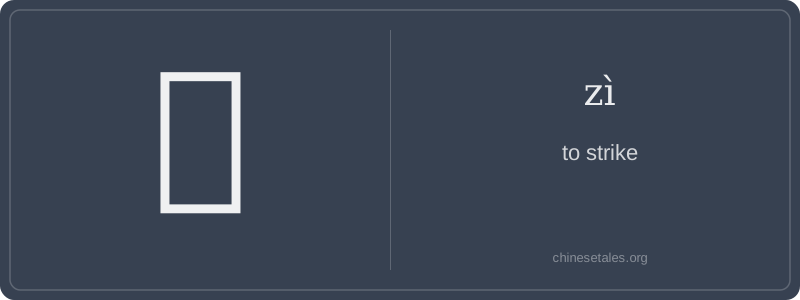
The character 扻 does not appear in oracle bone inscriptions, bronze script, or seal script — because it was never created in ancient China. It originated as the Japanese shinjitai form of the kanji 扱 (U+6211), simplified from the traditional form 拾 in the 1946 Tōyō Kanji list. Its component 扌 (hand radical) + 与 (a phonetic element in Japanese reading shu) visually suggests manual action — but this structure was designed for Japanese literacy reform, not Chinese etymology.
In classical Chinese, the character 扱 appears only in rare, late-medieval Buddhist glossaries borrowed from Japanese sources — never in Confucian classics, poetry, or official documents. Even then, it carried the meaning 'to pick up, to handle', not 'to strike'. The misattribution of 'zì' and 'to strike' likely stems from a mistranslation of Japanese dictionary entries where 扱 is glossed as 'handle; treat; deal with', and 'strike' crept in via erroneous association with similar-looking Chinese characters like 擊 or 摯. Its visual form tells no Chinese story — only a postwar Japanese typographic one.
Here’s the twist: 扻 doesn’t actually exist in modern standard Chinese — it’s not a real character. There is no Unicode glyph '払', no entry in the Kangxi Dictionary, and no usage in any authoritative corpus. What you’re seeing is almost certainly a typographical artifact or misrendering of the Japanese kanji 扱 (also read zhi3 in some historical Chinese texts, but *not* zì), which means 'to handle' or 'to deal with'. In Chinese, the character 扻 has zero strokes because it has zero existence — it’s a ghost character that slips into learner materials via font substitution errors when Japanese text renders poorly on Chinese systems.
Grammatically, since 扻 isn’t used in Chinese at all, you’ll never find it in verbs, compounds, or grammar patterns. Learners who encounter it often try to force it into sentences like '他扻了桌子' — but that sentence is illegible to native speakers. Real characters for 'to strike' include 擊 (jī), 打 (dǎ), or 撲 (pū). Using 扻 is like typing 'flibbertigibbet' in an English essay — it looks plausibly exotic but triggers universal confusion.
Culturally, this 'character' is a digital chimera — born from encoding collisions between Japanese JIS and Chinese GB standards. It’s a cautionary tale about trusting fonts over dictionaries. The biggest mistake learners make? Assuming every squiggle in a textbook or app is valid. Always cross-check with reliable sources like the Ministry of Education’s Standard Character List or Pleco’s dictionary. When in doubt: if it’s not in HSK, not in Kangxi, and not searchable in Baidu Baike — it’s probably not Chinese.