扌
Character Story & Explanation
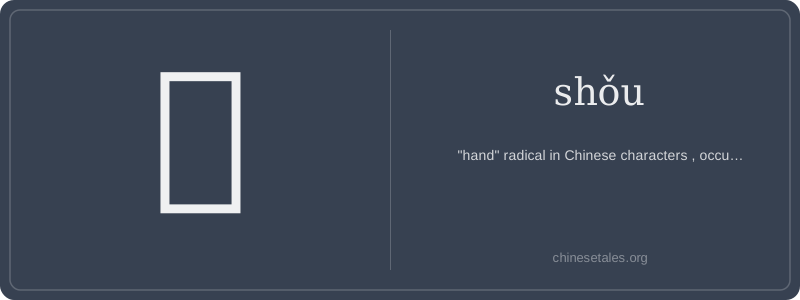
The earliest form of this radical appears in oracle bone inscriptions (c. 1200 BCE) as a clear pictograph of a hand with outstretched fingers and a prominent thumb — often drawn with four strokes to show palm and digits. By the Western Zhou bronze script era, scribes began simplifying it for speed: the wrist line elongated downward, fingers merged into two quick strokes, and the thumb curved inward — resulting in the three-stroke shape we know today. The final stroke (the downward hook) isn’t a finger, but a stylized wrist-and-forearm line anchoring the hand to the body — a subtle reminder that in Chinese writing, even radicals carry anatomical logic.
This simplified hand didn’t just shrink — it specialized. While the full character 手 (shǒu, 'hand') remained for nouns and independent use, the radical form 扌 emerged exclusively for left-side positioning in phono-semantic compounds. Classical texts like the *Shuōwén Jiězì* (100 CE) formally codified it as the 'hand radical', noting its role in 'characters denoting motion initiated by the hand'. Its quiet persistence — unchanged for over two millennia — reflects how deeply Chinese orthography links gesture, intention, and language: every time you write 提 or 拉, you’re echoing a Bronze Age scribe’s wrist flick.
Think of 扌 not as a standalone character, but as the Chinese equivalent of the Latin prefix 'manu-' (as in 'manual' or 'manufacture') — it’s a silent, shape-shifting hand that slips into characters to signal action, control, or physical contact. Unlike English prefixes, though, 扌 never appears alone; it’s always tucked on the left side of compound characters like a backstage stagehand who never takes a bow — you’ll see it in 提 (tí, 'to lift'), 把 (bǎ, 'to hold'), and 打 (dǎ, 'to hit').
Grammatically, 扌 itself carries no pronunciation or independent meaning — it’s purely a semantic radical, a visual clue whispering 'this word involves the hand!' Learners often mistakenly try to read it aloud as 'shǒu' (its dictionary name), but in real words, it’s voiceless: you say tí, not *shǒutí. It’s like seeing the 'h' in 'ghost' — visible, meaningful historically, but silent in speech.
Culturally, 扌 embodies the Confucian ideal of embodied agency: many 扌-words imply intentional, socially embedded action — 把握 (bǎwò, 'to grasp/understand'), 推荐 (tuījiàn, 'to recommend', literally 'push + advise'), even 招待 (zhāodài, 'to host', from 'wave + receive'). A common pitfall? Assuming all left-side components are radicals — but 扌 is special: it’s the *only* form of the hand radical used in modern standard characters when positioned left. Mistaking it for other 'hand-like' shapes (like 又 or 攵) leads to misreading both meaning and tone.