扊
Character Story & Explanation
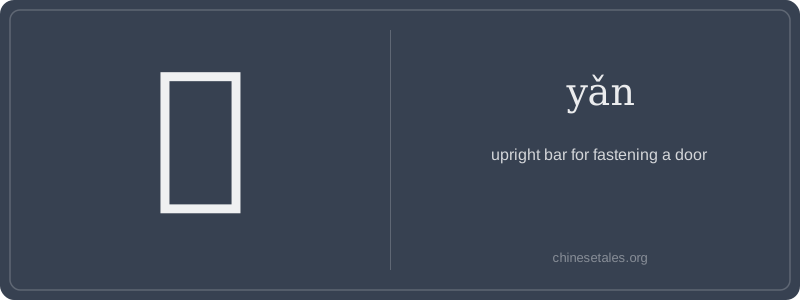
The earliest form of 扁 appears in bronze inscriptions as two parallel vertical strokes bracketing a horizontal bar near the top — a clear schematic of a vertical wooden bolt inserted into a door frame, with the crossbar acting as a handle or stop. Over centuries, the two outer strokes thickened and curved inward slightly, while the central bar shortened and solidified into the modern 'gate-like' enclosure. By the Han dynasty clerical script, the shape had stabilized into its current form: a symmetrical, boxy character suggesting containment and vertical rigidity — visually echoing how the actual 扁 bars stood upright and held things in place.
This character appears in the Rites of Zhou (Zhōu Lǐ), describing palace gate mechanisms, and later in Du Fu’s poetry where 扃扅 evokes domestic quietude and integrity. The visual logic is brilliant: the outer strokes are the door posts; the inner stroke is the bar dropped between them. No extra flourishes — just structure, function, and balance. Its endurance isn’t due to frequency, but to precision: in a language rich with synonyms for 'door', 扁 alone names the silent, vertical keeper.
Imagine standing before an ancient wooden gate in a Zhou dynasty courtyard — not the swinging kind, but a heavy, sliding door secured by a sturdy vertical bar that drops into a socket in the threshold. That’s 扊 (yǎn): not a door itself, not a hinge, but the humble, essential *upright fastening bar*. It’s a hyper-specific architectural term — so niche that even many native speakers only encounter it in classical texts or restoration work. Its meaning is tactile and mechanical: it *holds*, *locks*, *stabilizes* — always vertical, always functional, never decorative.
Grammatically, 扁 is almost never used alone in modern speech. You’ll find it only in compound nouns like 扃扅 (jiōng yǐ) — a literary duo meaning 'door and its fastenings', often appearing in idioms about household security or seclusion. It’s never a verb ('to bar') or an adjective ('barred'); confusingly, it doesn’t mean 'to close' — that’s 关 (guān). Learners sometimes misread it as 扇 (shàn, 'fan') due to visual similarity, but 扇 has nothing to do with doors — it’s flat, rotating, and airy. 扁 carries weight, gravity, and silence.
Culturally, 扁 embodies pre-modern Chinese material ingenuity: no locks, no keys — just precisely fitted wood. Its rarity today makes it a linguistic fossil. Mistake it for 扁 (biǎn, 'flat') or 扇, and you’ll conjure images of flattened tofu or fluttering fans instead of a secure gate. Native speakers may pause to recall it — not because it’s hard, but because it belongs to a world of timber joints and ritual thresholds, not WeChat messages.