戁
Character Story & Explanation
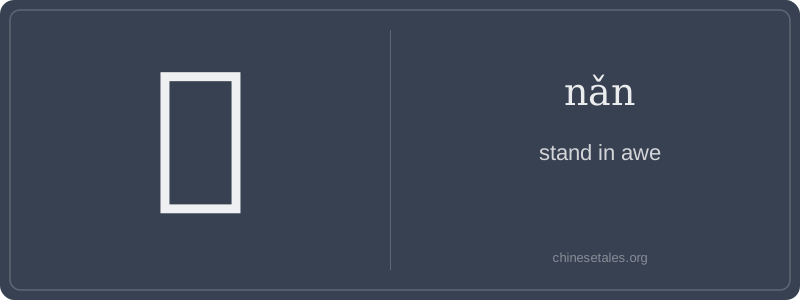
The earliest form of 戁 appears in bronze inscriptions (c. 1000 BCE) as a complex composite: on the left, a variant of 心 (xīn, ‘heart/mind’) — but stylized with three dots representing emotional intensity — and on the right, a simplified depiction of a person kneeling with arms raised in ritual submission (a precursor to the modern 友 or 攴 shape, though here specifically evoking prostration). Over centuries, the kneeling figure evolved into the phonetic component 南 (nán), whose sound approximated the original word — while the heart radical remained, anchoring the meaning in internal feeling. By the Han dynasty, the structure stabilized as 忄 + 南, visually merging emotional vulnerability with directional symbolism (south was associated with reverence in early cosmology).
This evolution wasn’t arbitrary: 南 (nán) didn’t just lend sound — in ancient ritual geography, the south-facing altar was where rulers received Heaven’s mandate, making 南 a subtle semantic echo of awe before cosmic authority. The character thus fused physiology (heart), posture (kneeling), and cosmology (south-altar) into one ideograph. You’ll find 戁 in the *Book of Rites* (《礼记》) describing how sages ‘stand in awe before ritual propriety’ — and in Wang Anshi’s essays, contrasting superficial decorum with genuine 戁 — revealing how deeply its meaning is rooted in sincerity of moral response, not mere outward form.
Imagine standing before something so vast, ancient, or sacred that your knees go weak and your breath catches — that’s the visceral, almost physical awe captured by 戁 (nǎn). It’s not polite respect like 敬 (jìng) or intellectual admiration like 欣 (xīn); it’s spine-tingling reverence, often tied to heaven, ancestors, or overwhelming moral authority. In classical and literary Chinese, 戁 appears almost exclusively as a stative verb or adjective describing one’s inner state — never as a transitive verb (you don’t ‘nǎn someone’), and never in casual speech.
Grammatically, it’s nearly always used in fixed, elegant phrases: 戁然 (nǎn rán, ‘in awestruck manner’), 戁栗 (nǎn lì, ‘trembling with reverence’), or as a standalone descriptive term after a subject: 君子临渊而戁 (jūn zǐ lín yuān ér nǎn — ‘The noble person stands at the edge of a deep abyss and feels awe’). Learners sometimes mistakenly treat it like a modern action verb or confuse it with common synonyms — but 戁 has zero colloquial usage; you’ll never hear it in a café or WeChat message.
Culturally, 戁 carries Confucian gravity: it reflects the humility expected before cosmic order (天道), ancestral virtue, or ritual precision. A classic mistake is overusing it — this isn’t ‘impressed’ or ‘nervous’; it’s solemn, dignified, and slightly archaic. Think of it as the linguistic equivalent of bowing deeply in silence, not clapping politely. Its rarity today makes it a subtle marker of literary sophistication — spotting it in a Tang poem or Song essay signals you’re reading high-register classical Chinese.