懿
Character Story & Explanation
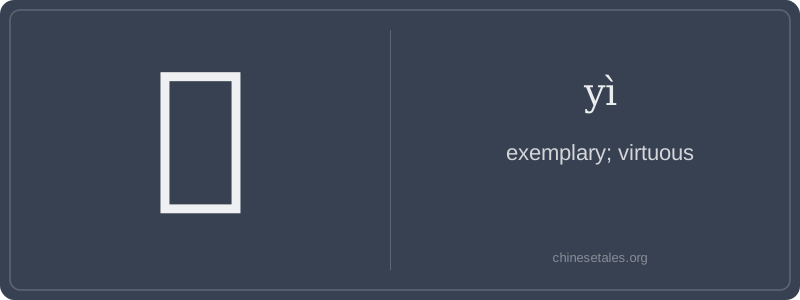
The earliest form of 懿 appears on Warring States bamboo slips — not as a pictograph, but as a richly layered ideograph. Its top half combines two 口 (mouths) over 一 (a horizontal line), echoing the ancient character 㬈 (yì), meaning ‘harmonious speech.’ Below sits 矢 (arrow), symbolizing precision and direction, and finally 心 (heart) — the radical anchoring it in moral intention. Over centuries, the upper 口s fused into 夫 + 一, then evolved into the ornate 允 + 次 structure we see today: 亠 (roof) + + 次 + 矢 + 心 — 22 strokes, each adding gravitas like layers of lacquer on a ritual vessel.
This character first appeared in the *Book of Songs* (Shījīng): ‘民之秉彝,好是懿德’ — ‘The people hold to their natural norms, loving this exemplary virtue.’ Here, 懿 wasn’t descriptive — it was aspirational, almost sacred. Its visual density mirrors its semantic weight: the repeated strokes evoke repetition of moral acts, the arrow points toward righteous action, and the heart confirms it’s inwardly rooted. Even today, when a temple plaque reads 懿德流芳 (‘Exemplary virtue flows fragrantly’), you’re seeing 2,500 years of calligraphic devotion distilled into one formidable character.
At its heart, 懿 (yì) isn’t just ‘virtuous’ — it’s *exemplary virtue*, the kind so radiant it becomes legendary. Think of a Confucian sage whose moral gravity bends light: this character carries weight, reverence, and quiet authority. It’s never casual — you won’t find it in texts about daily habits or modern self-help; it lives in classical eulogies, temple inscriptions, and imperial posthumous titles (like Empress Dowager Cixi’s full title: 孝欽慈禧端佑康頤昭豫莊誠壽恭欽獻崇熙配天興聖顯皇后 — where 懿 appears as part of 欽獻, 'reverent and exemplary').
Grammatically, 懿 is almost always an adjective — but not one you’d use predicatively like ‘She is virtuous.’ Instead, it clings to nouns as an attributive: 懿德 (exemplary virtue), 懿行 (exemplary conduct), 懿范 (exemplary model). You’ll rarely see it alone in speech — it’s too formal, too dense with historical resonance. Learners often mistakenly try to use it like 好 or 优秀, but that’s like quoting Shakespeare at a coffee shop: technically correct, socially jarring.
Culturally, 懿 is a ‘frozen virtue’ — preserved in fixed compounds and honorifics, especially for women of high moral stature (e.g., 懿母, 'exemplary mother' in ancestral tablets). A common error? Pronouncing it yī instead of yì — the fourth tone signals solemnity, not gentleness. Also, don’t confuse it with 忆 (yì, 'to remember') — same sound, wildly different soul: one lives in the heart-mind (心), the other in memory’s archive (乙+心).