懮
Character Story & Explanation
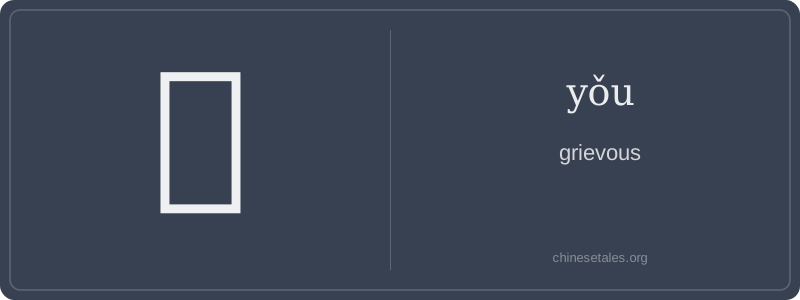
The earliest form of 懮 appears in bronze inscriptions of the Western Zhou (c. 1046–771 BCE) as a compound pictograph: on the left, 心 (xīn, 'heart'), and on the right, a simplified depiction of a person kneeling with arms crossed over the chest — a posture of deep mourning and submission. Over centuries, the kneeling figure evolved: the arms became 亜 (yà, a variant shape meaning 'second' or 'subordinate'), and the lower body condensed into 一 (yī) and 冂 (jiōng, 'enclosure'), eventually stabilizing as the right-hand component 憂 in seal script. By the Han dynasty, the left heart radical 忄 emerged as the standard form, streamlining the character while preserving its visceral core: a heart bowed under unbearable weight.
This visual logic shaped its semantic journey: from concrete ritual posture → internalized sorrow → moral gravity. In the Classic of Filial Piety, 懮 describes the son’s profound anxiety over his parents’ health — not mere worry, but filial dread. The character’s structure itself enacts its meaning: 忄 (heart) + 亜 (subordination) + 一 (a single line, suggesting exhaustion) + 冂 (enclosing pressure) = a heart pressed down, silenced, and held in reverence. No wonder it survives today only where sorrow must be both deep and dignified.
Think of 懮 (yǒu) as the Chinese equivalent of Shakespeare’s 'heavy heart' — not just sad, but *grievously* burdened, weighted down by sorrow so profound it feels physical. It’s a literary, almost archaic word: you won’t hear it in daily chats or HSK dialogues, but you’ll find it in classical poetry, historical novels, and solemn memorial inscriptions — like the English word 'woe' (as in 'woebegone'), which sounds mournful and carries Old English gravity. Its emotional tone is deep, quiet, and dignified — never whiny or theatrical.
Grammatically, 懮 functions almost exclusively as an adjective, typically preceding nouns ('懮心' — grievous heart; '懮患' — grievous peril), or in fixed four-character idioms. You’ll rarely see it alone in modern speech — unlike common synonyms like 伤心 (shāng xīn, 'heartbroken') or 难过 (nán guò, 'feeling bad'). Crucially, it’s *not* used predicatively without support: saying '他很懮' is unnatural; instead, you’d say '他忧心忡忡' (tā yōu xīn chōng chōng) — literally 'his heart brims with grievous care.' Learners often misapply it like a generic 'sad,' tripping over its literary weight and syntactic constraints.
Culturally, 懮 evokes Confucian restraint: sorrow that is internalized, unperformed, and morally significant — grief tied to duty, loss of virtue, or national calamity. In the Book of Songs, it appears in laments for fallen states; in Tang poetry, it shadows scholars exiled for integrity. Modern learners’ biggest mistake? Overusing it — like sprinkling 'thou' and 'hath' into casual emails. Reserve 懮 for moments when your heart doesn’t just ache — it *bows*.