懫
Character Story & Explanation
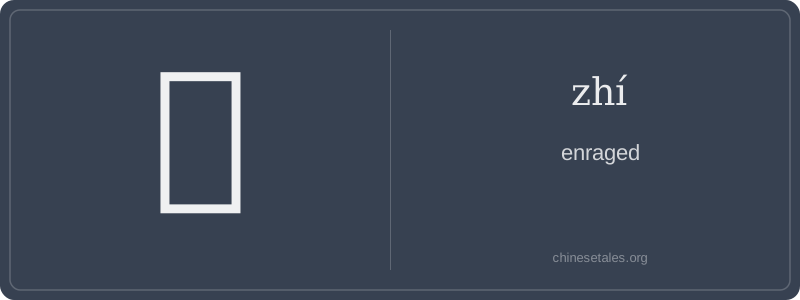
The earliest form of 懫 appears in Warring States bamboo slips as a compound ideograph: the heart radical (心) on the left, and 只 (zhǐ) on the right—a phonetic component originally meaning ‘to grasp’ or ‘to hold firmly’. Over centuries, the heart radical evolved into 忄 (the ‘heart’ variant used in left-position characters), while 只 simplified and stabilized its shape. By the Han dynasty clerical script, the two components fused visually into today’s balanced structure: 忄 + 只 — a compact, upright glyph suggesting emotional tension held in check, not released.
This visual restraint mirrors its semantic evolution: early texts like the *Zuo Zhuan* use 懫 to describe ministers whose outrage at royal misconduct is so intense it manifests physically—trembling hands, pallor, suppressed voice—but never loss of decorum. Unlike 怒 (which depicts ‘slave + heart’, implying raw, servile emotion), 懫’s 只 component evokes control: ‘holding fast’ to principle even amid fury. The character never meant ‘angry’ in the colloquial sense—it always implied anger tempered by cultivation, making it a hallmark of elite literati sensibility.
Imagine a Ming dynasty scholar, ink still wet on his brush, slamming it down after reading an official edict that unjustly stripped his family of land. His face is flushed, jaw clenched—not roaring, but radiating a silent, white-hot fury that freezes the room. That’s 懫 (zhí): not explosive anger like 怒 (nù), nor simmering resentment like 恨 (hèn), but a profound, dignified, almost aristocratic rage—cold, controlled, and morally charged. It’s the kind of fury that appears in classical poetry when heaven itself seems unjust.
Grammatically, 懫 is nearly extinct in modern spoken Chinese—it survives almost exclusively in literary compounds or set phrases, always as a stative adjective or in parallel structures (e.g., 懫憤, 懫恚). You’ll never hear ‘wǒ hěn zhí’ in casual speech; it doesn’t take degree adverbs like 很. Instead, it appears in formal writing or historical narratives: ‘他面露懫色’ (His face revealed 懫 expression)—note how it modifies nouns directly, rarely verbs. Learners often misapply it as a verb or try to conjugate it, which instantly sounds archaic or comically overwrought.
Culturally, 懫 carries Confucian weight: this isn’t petty anger—it’s righteous indignation rooted in moral principle, often directed at injustice, hypocrisy, or betrayal of ritual propriety (lǐ). Mistake it for everyday anger, and you’ll unintentionally elevate your frustration to the level of a sage’s lament. Its rarity makes it a linguistic time capsule—using it today signals either deep classical literacy or deliberate stylistic archaism.