懦
Character Story & Explanation
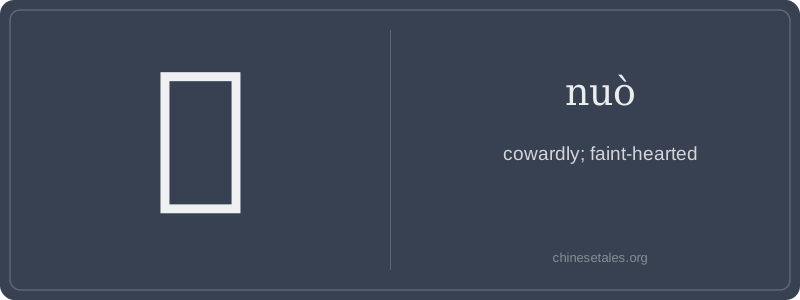
The earliest form of 懦 appears in seal script (c. 3rd century BCE), built from two clear components: the heart-mind radical 忄 (a variant of 心 xīn) on the left, and the phonetic component 奴 (nú, 'slave') on the right. The original bronze inscriptions show 心 cradling 奴 — not literally depicting slavery, but graphically encoding a psychological state: a heart dominated by submission. Over centuries, the left side standardized into the three-stroke 忄, while 奴 evolved from a kneeling figure with bound hands into today’s simplified form — 7 strokes total on the right, making 17 strokes overall.
This visual logic anchored its meaning: a heart enslaved by fear or weakness. By the Warring States period, philosophers like Mencius referenced such inner states when criticizing rulers who ‘yielded to power instead of righteousness’ — though 懦 itself appears most vividly in Tang and Song dynasty poetry, where poets lamented the ‘懦节’ (nuò jié, ‘cowardly conduct’) of officials who compromised ethics for safety. The character never meant physical timidity alone — it always carried this moral weight: the heart letting the slave (fear, self-interest, social pressure) take the reins.
At its core, 懦 (nuò) isn’t just ‘cowardly’ — it’s a culturally loaded word that implies a *moral failing of spirit*, not mere fear. In classical and modern Chinese alike, it carries quiet shame: someone who lacks moral courage (勇 yǒng) to stand up for what’s right, or who yields too easily under pressure. It’s rarely used lightly; calling someone 懦 is a serious judgment — like saying they’ve betrayed their own integrity. You’ll almost never hear it in casual speech among friends (too harsh!), but you’ll find it in essays, historical critiques, and literary descriptions of flawed heroes.
Grammatically, 懦 functions almost exclusively as an adjective before nouns (e.g., 懦夫 nuòfū — 'coward') or after verbs like 是 (shì) or 显得 (xiǎn de). It doesn’t take degree adverbs like 很 (hěn) very often — you’d say 他很胆小 (tā hěn dǎnxiǎo) for 'he’s timid', but 懦 itself feels too stark for that softener. Instead, it appears in compound forms (like 懦弱 nuòruò) or paired with verbs like 表现得 (biǎoxiàn de): 'He behaved in a cowardly way' → 他表现得很懦弱 (tā biǎoxiàn de hěn nuòruò).
Learners often misapply 懦 as a direct synonym for 'afraid' — but fear is 害怕 (hàipà), anxiety is 焦虑 (jiāolǜ), and shyness is 害羞 (hàixiū). 懦 is about *character collapse*, not emotion. Confusing it with those can unintentionally insult someone’s moral fiber — imagine telling your bold, outspoken teacher 你真懦! (Nǐ zhēn nuò!) — oof. Also, it’s never used attributively without modification: you wouldn’t say *懦人*; it’s always 懦夫, 懦弱之人, or similar.