懥
Character Story & Explanation
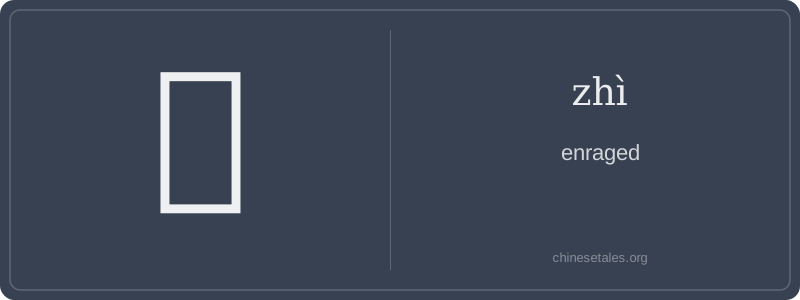
The character 懥 first appeared in seal script (around 200 BCE), evolving from a bronze inscription combining 心 (xīn, ‘heart/mind’) on the left and 智 (zhì, ‘wisdom’) on the right — but crucially, 智 itself was originally written with 矢 (shǐ, ‘arrow’) atop 日 (rì, ‘sun’), suggesting sharp, piercing insight. Over centuries, the top of 智 simplified: 矢 + 日 became 知 (zhī, ‘to know’), then later re-borrowed the more complex 智 form — but in 懥, the right side retained the older, more visually aggressive structure: 矢 (arrow) piercing through 日 (sun), implying mental agitation so intense it feels like an arrow striking the heart-mind.
This visual logic deepened in meaning during the Warring States period. Mencius and the Confucian canon used 懥 to describe the volatile inner state that precedes moral failure — not mindless rage, but the dangerous heat of unexamined desire or wounded pride. In the Great Learning, it appears in the phrase ‘身有所憤懥,則不得其正’ ('If the body harbors resentment or fury, the mind cannot be upright'), anchoring it firmly in ethical self-discipline. Its shape — heart pierced by arrow-sun — thus became a warning glyph: wisdom without emotional rectification is not wisdom at all, but a weapon turned inward.
At its core, 懥 (zhì) isn’t just ‘angry’ — it’s the white-hot, chest-tightening fury that rises *before* the outburst: the silent, trembling restraint of someone biting their tongue so hard they taste blood. It’s a classical, literary term rarely heard in daily chatter; modern Mandarin prefers 生气 (shēngqì) or 愤怒 (fènnù). Think of it as the emotional equivalent of holding your breath underwater — intense, internalized, and culturally loaded with Confucian restraint.
Grammatically, 懥 almost never stands alone. It appears almost exclusively in fixed, two-character compounds like 憂懥 (yōu zhì — 'anxious anger') or 懥懥 (zhì zhì — reduplicated for heightened intensity, as in classical texts). You won’t say ‘I am 懥’ — instead, you’ll find it in phrases like ‘憂懥交加’ (yōu zhì jiāo jiā — 'anxiety and rage intertwining'), where it functions as a noun-like emotional state, not an adjective. Learners mistakenly try to use it predicatively (e.g., *他懥了), but it doesn’t conjugate like modern adjectives — it belongs to the syntax of classical prose and philosophical discourse.
Culturally, 懥 reveals how traditional Chinese thought treats emotion not as raw impulse, but as a *disturbance of qi* — a physiological imbalance needing regulation. The Great Learning (Dà Xué) famously lists 懥 as one of the four inner disturbances (alongside joy, sorrow, and fear) that must be ‘rectified’ before self-cultivation can begin. That’s why learners who force it into casual speech sound oddly archaic — like quoting Shakespeare at a coffee shop. Its rarity isn’t linguistic neglect; it’s a deliberate preservation of a precise, ethically charged psychological category.