懠
Character Story & Explanation
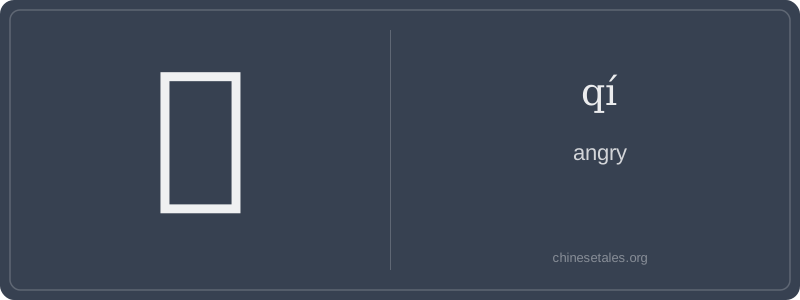
The earliest form of 懠 appears in bronze inscriptions of the Western Zhou (c. 1046–771 BCE) as a composite glyph: atop the heart radical (心) sat a simplified depiction of a person (人) holding what scholars reconstruct as a ritual tally or jade tablet (possibly the precursor to the top component 旣). This wasn’t rage — it was the visceral tightening of the chest when duty and honor collide. Over centuries, the person + tally evolved into the upper 旣 (jì, ‘already’), while the heart radical sank to the bottom as 心 — yet retained its original meaning by association, not phonetics. By the Han dynasty, the structure stabilized as 旣 + 心, visually encoding ‘a heart already filled with righteous grievance.’
This evolution mirrors its semantic journey: from concrete ritual offense (e.g., violating ancestral rites) to abstract moral outrage. In the Book of Songs (Shījīng), 懠 appears in Ode 238: ‘我心匪石,不可轉也;我心匪席,不可卷也。威儀棣棣,不可選也。’ — where later commentators read 懠 as the unspoken undercurrent: the speaker’s heart, unmoved like stone, burns with quiet indignation at slander. Its visual weight — that heavy 旣 pressing down on the heart — became inseparable from its meaning: not explosive fury, but the unbearable stillness before justice demands voice.
懠 (qí) isn’t just ‘angry’ — it’s the kind of anger that simmers beneath quiet dignity: restrained, morally charged, and deeply personal. Unlike common words like 生气 (shēngqì) or 愤怒 (fènnù), 懠 appears almost exclusively in classical poetry, historical texts, and literary prose. It conveys a dignified, inward-facing indignation — the kind you’d feel when your integrity is questioned or a principle is violated, not when someone steals your seat on the bus. It’s rarely used in speech today; hearing it spoken aloud feels like stumbling upon a sealed scroll.
Grammatically, 懠 functions almost always as a verb (‘to be indignant’) or as a stative adjective (‘indignant’), but never as a noun (unlike 愤怒, which can mean ‘anger’ as a thing). You’ll see it in fixed patterns like ‘懠然’ (qí rán — ‘indignantly, with moral resentment’) or after subject + 懠 + object constructions: ‘君懠其不忠’ (The ruler is indignant at his disloyalty). Crucially, it doesn’t take aspect markers like 了 or 过 — its gravity resists casual temporal framing.
Learners often misread 懠 as ‘angry’ and drop it into modern conversational sentences — a classic faux pas that sounds archaic, even theatrical. Worse, some confuse it with 忒 (tuī/tè, ‘excessively’) due to visual similarity in cursive script. Remember: 懠 isn’t emotional volatility — it’s ethical temperature rising. Its rarity means encountering it is less about utility and more about stepping into the mindset of a Song dynasty scholar confronting injustice with silent, unyielding fire.