怼
Character Story & Explanation
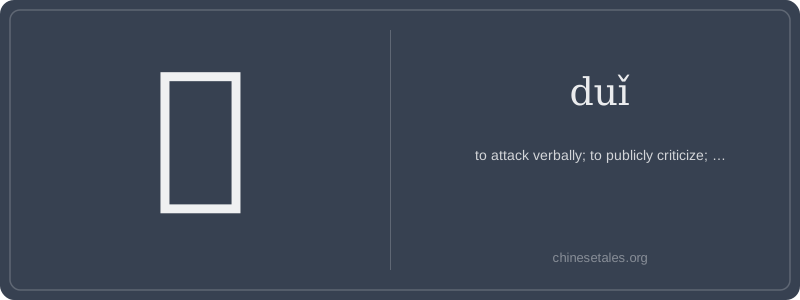
Forget oracle bones — 怼 has no ancient pedigree. Its earliest attested form appears in Qing-dynasty regional dictionaries as a dialectal variant of 惴 (zhuì, ‘anxious’) or 毒 (dú, ‘poisonous’), but visually, it’s a late fusion: the heart radical (心) at the bottom anchors emotion, while the top component (对) — originally meaning ‘to match’ or ‘oppose’ — was borrowed purely for sound (duì → duǐ). Over time, scribes simplified 对’s complex strokes into a compact, angular shape resembling two crossed swords above 心 — a visual pun: ‘heart + clash’. By the 20th century, this hybrid character was rare, surviving only in rural Henan and Hebei speech as a guttural, emphatic verb meaning ‘to scold fiercely’.
The real transformation happened online: around 2012, netizens rediscovered 怼 in dialect dictionaries and repurposed it as the perfect glyph for viral call-outs — its sharp top strokes looked like shouting exclamation marks, its 心 radical hinted at raw feeling, and its rarity made it feel rebellious and insider-y. Unlike classical characters shaped by scholars, 怼 was crowd-sourced: no dictionary editor approved it; memes did. It’s a rare case where internet culture didn’t just adopt a character — it resurrected, redefined, and re-radicalized one.
At its core, 怼 (duǐ) isn’t just ‘to criticize’ — it’s the sound of a verbal jab landing: sharp, public, emotionally charged, and often laced with righteous indignation. Think less ‘constructive feedback’ and more ‘calling someone out on Weibo with screenshots’. It carries the heat of face-to-face confrontation — you wouldn’t 怼 your boss in person (too risky!), but you might 怼 a celebrity’s tone-deaf tweet or a friend’s unfair assumption in a group chat. The verb is almost always transitive and demands an object: you 怼 *someone* or *something*, never just ‘get upset’.
Grammatically, 怼 behaves like a colloquial action verb: it can take aspect particles (怼了, 正在怼, 被怼), and frequently appears in reduplicated form (怼怼) for playful or exaggerated effect — ‘I’m just gonna gently怼怼 you about that typo’. Learners often mistakenly use it like English ‘argue’ (intransitive) or confuse it with formal verbs like 批评 (pīpíng). But 怼 is inherently informal, internet-born, and socially edgy — it’s rarely found in official documents or polite speech.
Culturally, 怼 reflects China’s digital generation asserting voice in constrained spaces: it’s the linguistic equivalent of a raised eyebrow + folded arms + perfectly timed screenshot. Interestingly, while 怼 sounds like duì (‘oppose’, ‘match’), its modern meaning has *zero* classical roots — it’s a phonetic borrowing from Northern Mandarin dialects, revived and weaponized online around 2010. That’s why textbooks ignore it: it’s not ancient wisdom — it’s linguistic street art.