憪
Character Story & Explanation
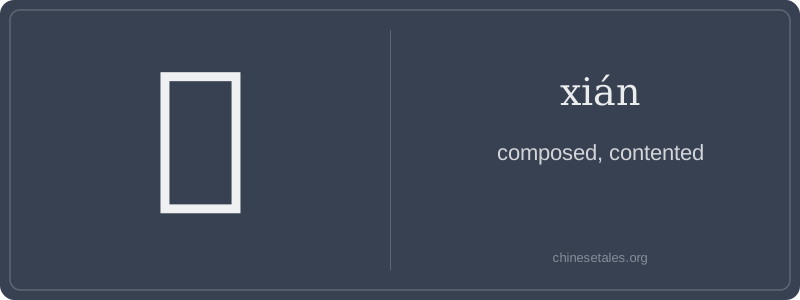
The earliest form of 憪 — though extremely scarce in oracle bone inscriptions — likely emerged from a bronze script variant combining 心 (xīn, ‘heart/mind’) on the left and 閒 (xián, ‘leisurely space between doors’) on the right. 閒 itself was originally two door panels (門) framing a gap (月, representing a moonlit void or open space). So visually, 憪 fused ‘mind’ + ‘spacious calm’ — a brilliant ideographic metaphor: mental stillness as an open, uncluttered courtyard within the heart. Over centuries, the right side simplified from 閒 to 閒’s cursive form, then to the modern 闲-like shape, while 心 retained its dot-and-hook essence, evolving into today’s 忄 (‘heart radical’) on the left.
This visual logic directly shaped its meaning: not passive idleness, but active inner spaciousness — the kind praised in the Zhuangzi when describing sages who ‘sit in forgetfulness’ (坐忘). By the Tang dynasty, poets like Wang Wei used 憪 in lines evoking mountain solitude: ‘松风自憪然’ (Pine-wind blows — self-composed, naturally). The character never became common because its meaning was too subtle for bureaucratic or daily use; it remained the preserve of literati seeking precision in emotional nuance — a linguistic haiku in one glyph.
Let’s be honest: 憪 (xián) is a quiet rebel — a character so serene it’s practically meditating, yet so rare it’s almost mythical. Its core meaning isn’t just ‘composed’ or ‘contented’ — it’s the deep, unshakable stillness of someone who has no need to prove anything: eyes half-lidded, breath even, heart settled like still water after rain. Think less ‘I’m fine’ and more ‘I am fundamentally whole.’ It’s not an adjective you slap onto a sentence like 快乐 or 安静; it’s literary, poetic, often used in classical-style prose or introspective writing — never in casual chat or HSK textbooks.
Grammatically, 憪 behaves like a stative verb or descriptive adjective, usually appearing after subjects in predicate position (e.g., 他神色憪然), or paired with 然/然 as in 憪然. You’ll almost never see it alone in modern speech — it needs companions like 然, 自, or 定 to feel natural. Learners sometimes force it into colloquial contexts ('I feel 憪!'), but that’s like wearing silk robes to a coffee run: technically possible, culturally jarring. It also resists reduplication (no *憪憪) and doesn’t take aspect particles like 了 or 过 — its tranquility is timeless, not event-bound.
Culturally, 憪 echoes Daoist and Chan Buddhist ideals of effortless presence — the state of wu-wei (non-action) made visible in ink. Confucians admired it too: in the Book of Rites, 憪 appears in descriptions of ritual composure, where inner stillness manifests as dignified outward calm. A common mistake? Assuming it’s interchangeable with 闲 (xián, ‘leisure’) — but while 闲 is about free time, 憪 is about inner fullness. They share pronunciation by coincidence, not kinship.