憩
Character Story & Explanation
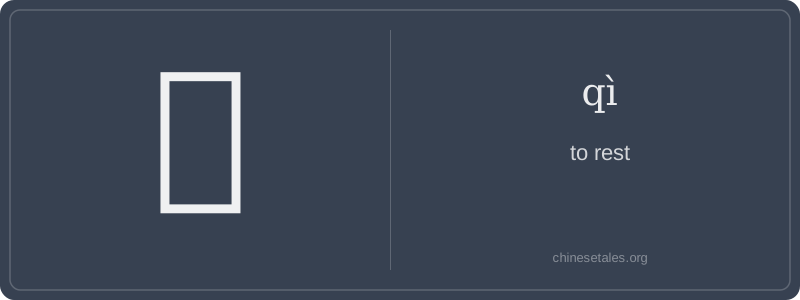
The earliest form of 憩 appears in bronze inscriptions as a compound pictograph: a person (人) sitting under a tree (木), with a heart (心) added later to emphasize the mental dimension. Over time, the ‘person under tree’ simplified into the top component — the ‘self’ radical 自 plus the ‘resting’ element 攵 (a hand holding a stick, suggesting action ceasing), which fused into the modern upper part 自 + 攵. Below, the 心 radical remained intact, anchoring the emotional resonance. By the Han dynasty, the structure stabilized: the top conveys ‘ceasing movement’, the bottom declares ‘in the heart’ — together, ‘to cease movement inwardly’.
This visual logic shaped its literary life: in Du Fu’s poetry, 憩 describes the poet pausing mid-journey to absorb mist over rivers; in the *Classic of Mountains and Seas*, it marks sacred resting places where immortals pause before ascending. The character never meant mere laziness — it always implied reverence for the pause itself. Even today, when you see 憩 carved above a pavilion gate, it’s an invitation not just to sit, but to let your heart catch up with your feet.
At its heart, 憩 (qì) evokes a deep, quiet pause — not just stopping, but settling in stillness, like a bird folding its wings on a branch. Unlike the everyday rest implied by 休息 (xiūxi), 憩 carries literary weight and poetic stillness; it’s the kind of rest you’d find in a Tang dynasty mountain poem or a Ming garden inscription. It’s rarely used in casual speech — you won’t hear someone say ‘我憩一下’ — but appears in formal writing, classical allusions, and place names (e.g., 憩园, Qì Yuán — ‘Garden of Repose’).
Grammatically, 憩 is an intransitive verb meaning ‘to rest’ or ‘to stay briefly’, often with a sense of temporary, intentional pause. It usually appears after time/duration phrases or in parallel structures: ‘行至山腰,遂憩于松下’ (Having climbed to the mountainside, we rested beneath the pine). Learners sometimes mistakenly use it as a noun (like ‘a rest’) or try to add objects — but 憩 takes no object, and never means ‘to rest something’. Also, it’s almost always monosyllabic in usage — you won’t see it reduplicated like 看看.
Culturally, 憩 embodies the Daoist and literati ideal of *wu wei* — effortless presence. Its radical 心 (heart/mind) signals this isn’t physical idleness, but inner recalibration. A common mistake? Confusing it with 息 (xī, ‘to breathe’ or ‘to cease’) — same radical, similar stroke count, but 息 implies cessation or expiration, while 憩 implies renewal through stillness. Think: 息 = breath stops; 憩 = heart settles.