憨
Character Story & Explanation
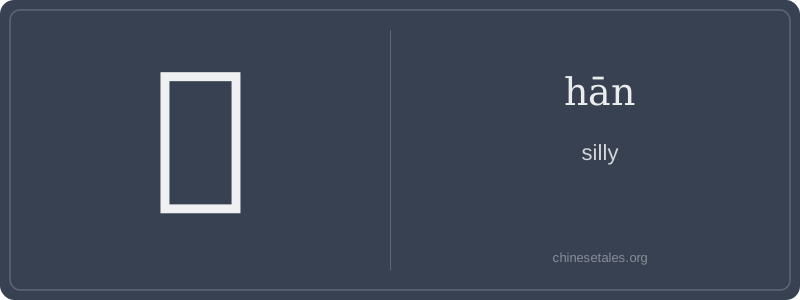
The earliest trace of 憨 appears not in oracle bones but in late Warring States bamboo slips, where it evolved from the character 甝 (hān), meaning 'white tiger'—a rare, majestic beast symbolizing purity and untamed sincerity. Visually, the modern form combines the heart radical 心 (bottom) with 敢 (gǎn, 'to dare') above—a clever phonetic-semantic blend: 敢 hints at bold, unguarded action (like a child declaring the emperor has no clothes), while 心 roots it in inner authenticity. Over centuries, the top simplified from 甝’s complex tiger-head shape to 敢’s cleaner strokes, and the bottom solidified as 心—not 忄—emphasizing deep-seated nature, not fleeting emotion.
This visual logic shaped its meaning: a person whose heart is so open and uncalculated that their actions seem naively bold—hence 'silly' with moral warmth. In Ming dynasty vernacular fiction like *Jin Ping Mei*, 憨 described servants whose loyalty made them comically literal-minded; by Qing-era folk songs, it celebrated peasants’ unpretentious honesty. Unlike clinical terms for intelligence, 憨 never appears in medical or philosophical texts—it lives in laughter, teasing, and tender nicknames.
Imagine your friend Xiao Li, who just tried to charge his phone by holding it under a running tap—'because water conducts electricity, right?'—then beams at you with wide-eyed pride. That’s 憨: not stupid, not ignorant, but a warm, unselfconscious kind of silliness rooted in sincerity and guilelessness. It carries zero malice or condescension—it’s affectionate, often endearing, and deeply tied to rural or traditional Chinese values where simplicity is virtue.
Grammatically, 憨 is almost always an adjective (never a verb), used before nouns (憨娃 'silly kid') or after 是/很/真 (他是真憨 'He’s genuinely silly'). Crucially, it’s rarely used alone as a noun ('a 憨')—that would sound unnatural. Learners often overgeneralize it like English 'silly', but 憨 implies innocence, not foolishness; calling someone 愚蠢 or 傻 in the same context would be harsh or insulting, while 憨 softens the edge with charm.
Culturally, 憨 appears in northern dialects and folk literature far more than formal writing—it’s the heart of characters like the lovable oaf in *Water Margin* or the earnest farmer in Shaanxi opera. A classic pitfall? Using it for someone who’s actually careless or incompetent—憨 isn’t about lack of skill, but about charmingly misplaced earnestness. Think 'earnestly clueless', not 'incompetent'.