憝
Character Story & Explanation
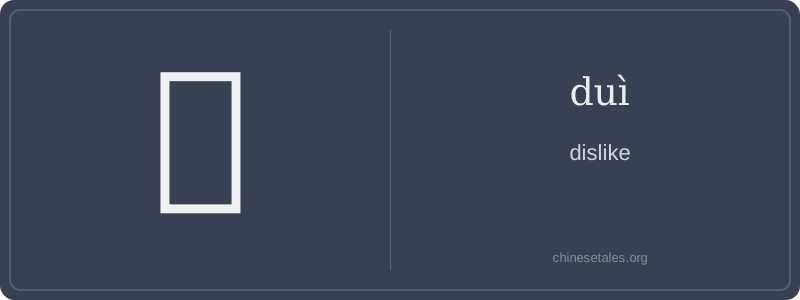
The earliest form of 憝 appears in bronze inscriptions of the Western Zhou, where it combined two elements: a simplified depiction of a ‘heart’ (❤️-like shape, later standardized as 心) and the phonetic component 兑 (duì), which originally showed a person opening their mouth wide — perhaps to express strong feeling. Over centuries, the heart radical settled at the bottom (as 忄 in many characters), but in 憝, it appears in its full form at the bottom, anchoring the meaning in visceral emotion. The upper part evolved from 兑’s ancient glyph — three horizontal strokes representing breath or voice, plus an open mouth — gradually stylized into the modern 兌 with its distinctive ‘eight’ (八) atop ‘mouth’ (口).
This visual fusion — ‘heart’ + ‘open-mouthed expression’ — perfectly captures its semantic core: an inner emotional reaction so intense it demands vocal or moral articulation. In the Book of Rites (Lǐjì), 憝 appears in phrases like ‘憎以立其善,憝以明其恶’ (‘Hatred establishes virtue; disgust clarifies evil’), linking it to ethical discernment. Unlike fleeting anger, 憝 was seen as the heart’s sober verdict — hence its enduring association with principled rejection rather than impulsive aversion.
Imagine a stern Confucian scholar in the Han dynasty, reading a scroll that praises a corrupt official — his brow furrows, his hand tightens around the bamboo slip, and a quiet, deep-seated revulsion rises in his chest. That’s not just anger or annoyance; it’s 憝 (duì): a classical, literary word for profound, morally grounded *dislike* — the kind that wells up from the heart (hence the 心 radical) when principle is violated. It’s not casual distaste like 讨厌 (tǎoyàn); it’s weighty, almost righteous, and rarely used in speech today.
Grammatically, 憝 functions almost exclusively as a verb in formal or literary contexts, often in parallel structures or classical compounds (e.g., 憎憝). You won’t hear it in ‘I dislike coffee’ — that’s 讨厌 or 不喜欢. Instead, you’ll find it in historical texts or modern essays quoting antiquity: ‘他深恶而痛绝之’ (He abhors and utterly rejects it), where 憝 appears in the fixed phrase 痛绝 (tòng jué) — but note: 憝 itself isn’t used alone in modern spoken clauses. Learners mistakenly try to substitute it for ‘dislike’ in everyday sentences — a red flag that instantly marks their Mandarin as archaic or unnatural.
Culturally, 憝 carries the gravity of moral judgment. It implies the object of dislike is *deserving* of condemnation — not just unpleasant, but ethically objectionable. Its rarity in modern usage makes it a ‘time capsule’ character: if you see it, you’re likely reading pre-20th-century prose, legal edicts, or rhetorical flourishes in serious journalism. Mispronouncing it as duǐ (third tone) is common — but it’s strictly duì (fourth), rhyming with ‘dye’ — a subtle cue that this emotion is decisive, not wavering.