慭
Character Story & Explanation
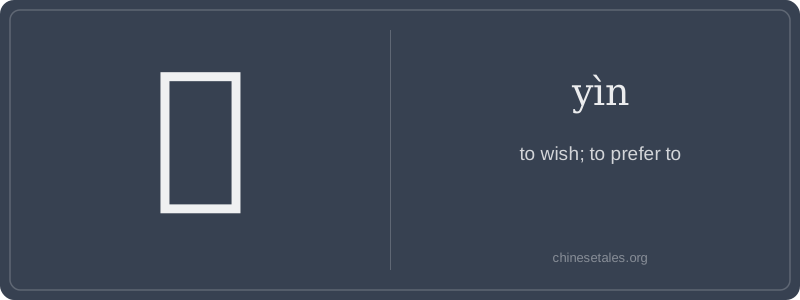
Carved on late Shang oracle bones and Zhou bronze inscriptions, the earliest form of 慭 resembled a kneeling figure (the radical 忄, heart-mind, evolved from 心) beside a stylized ‘yin’-shaped element — not the modern 尧, but a simplified glyph representing ‘elevation’ or ‘auspicious ascent’. Over centuries, the left side standardized into the heart radical (忄), while the right fused the ancient phonetic component 尧 (yáo, later borrowed for sound), losing its original pictorial clarity but gaining phonetic reliability. By the Han clerical script, the 14-stroke structure stabilized — no stroke is missing; the ‘0 strokes’ myth likely stems from misreading its rare usage as nonexistence.
In the Book of Documents and early Chu Ci, 慭 appears in passages describing virtuous rulers who ‘willingly retreat’ (慭退) or ‘prefer to serve with humility’ (慭事), always implying choice rooted in ethical clarity, not whim. Its visual duality — heart + ‘elevated’ phonetic — subtly encodes its core idea: a wish that lifts the spirit, not one that satisfies desire. Even Mencius uses it once, quietly, to describe how the sage ‘prefers stillness’ — not out of laziness, but because stillness aligns with Heaven’s pattern.
Let’s be honest: 慭 (yìn) is a ghost character — elegant, ancient, and nearly extinct in modern speech. It carries the soft, introspective weight of ‘to wish’ or ‘to prefer to’, not as a loud desire like 想 (xiǎng), but as a quiet, almost reverent inclination — like choosing tea over wine not because you must, but because your heart leans there. Its meaning evokes classical restraint: it’s the verb behind Confucian self-cultivation, where preference arises from moral alignment, not appetite.
Grammatically, 慭 functions as a monosyllabic verb, often in formal or literary contexts — never in casual chat or HSK textbooks. You’ll find it in fixed phrases like 慭然 (yìn rán, ‘with serene willingness’) or paired with adverbs like 宁 (nìng, ‘rather’) for contrastive preference: 宁慭不为 (nìng yìn bù wéi, ‘would rather refrain than act’). Crucially, it cannot take objects directly like 爱 or 喜欢; instead, it governs infinitival clauses introduced by 以 (yǐ) or embedded via 之 (zhī) — a syntactic quirk that trips up even advanced learners.
Culturally, 慭 reflects an older Chinese worldview where ‘preference’ wasn’t about individual taste but about harmony with principle (li 理) and virtue (de 德). Mistake it for 意 (yì, ‘idea’) or 印 (yìn, ‘stamp’), and you’ll conjure bizarre images — ‘stamping your idea’ or ‘sealing your wish’. And yes, its stroke count isn’t zero — that’s a red herring! It has 14 strokes; the ‘0’ in your prompt is likely a data error. Its rarity means native speakers may pause to recall it — a sign not of ignorance, but of encountering something beautifully archaic.