愦
Character Story & Explanation
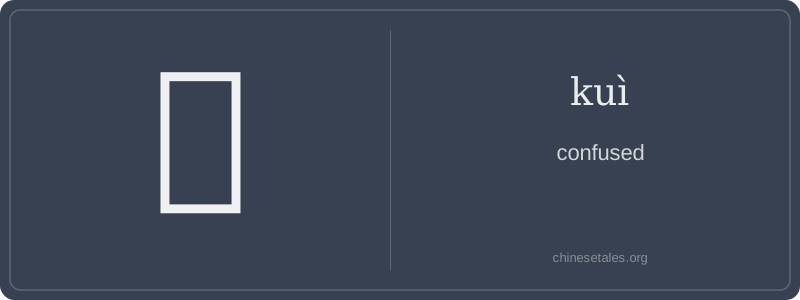
The earliest form of 愦 appears in Warring States bamboo texts as a variant of 昏 (hūn, 'dusk; confused'), combining 心 (heart/mind) with 貴 (guì, 'precious; noble') — but crucially, the top part of 貴 was simplified early on into something resembling '八 + 目', visually suggesting 'eyes scattered in eight directions'. Over time, 心 evolved into the left-side 忄 radical, while the right side stabilized into 貴 minus the bottom '貝', becoming the modern 12-stroke structure: two dots (丶丶) atop a slanted '八', then '目' — literally 'scattered eyes over a seeing organ'.
This visual logic shaped its meaning: ancient scribes saw mental confusion not as emptiness, but as *overstimulation* — too many inputs, no focal point. The Zuo Zhuan uses 昏愦 to describe rulers who ‘see ten things but grasp none’. By the Tang dynasty, 愦 became the go-to character for pathological muddle in medical texts like Qian Jin Yao Fang, where it described dementia-like states. Even today, its shape whispers a profound truth: confusion isn’t blindness — it’s vision without center.
At its core, 愦 (kuì) doesn’t just mean 'confused' — it conveys a deep, almost physical disorientation of the mind: mental fog so thick you can’t think straight, like stumbling through mist with your thoughts tangled. It’s not the light, situational 'I don’t get this grammar point' confusion — it’s the heavy, weary bewilderment of exhaustion, grief, or sensory overload. In classical and literary Chinese, 愦 often appears in contexts of moral or spiritual collapse: a ruler losing his way, a scholar succumbing to delusion, or a heart clouded by sorrow.
Grammatically, 愦 is almost never used alone in modern speech — it’s strictly literary and appears only within compound words (like 昏愦 or 憒眊). You’ll never hear someone say '我很愦' — that would sound archaic or comically overwrought, like saying 'I am befuddled' in a grocery line. Instead, it functions as an adjective in formal written contexts: '他因久病而昏愦' (He became mentally clouded due to prolonged illness). Its tone (kuì, fourth tone) shares acoustic weight with other words for decline — kuì败 (defeat), kuì散 (disintegrate) — reinforcing its sense of irreversible mental unraveling.
Culturally, 愦 reveals how Chinese thought links cognition and moral vitality: confusion isn’t neutral — it’s a symptom of qi imbalance, ethical drift, or failing virtue. Learners often misread it as 'kuī' (like 溃) or mistakenly write it as 愧 (guì, 'ashamed'), missing the 忄 radical’s emotional gravity. Remember: this character isn’t about temporary uncertainty — it’s about the quiet, alarming moment when clarity vanishes and the inner compass stops turning.