憍
Character Story & Explanation
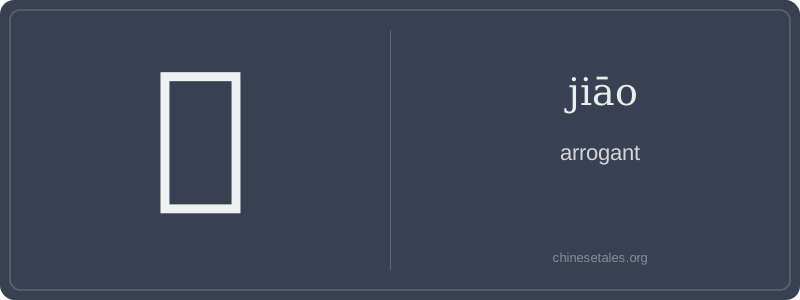
The earliest trace of 憍 appears not in oracle bones but in Warring States bamboo slips and Han dynasty seals — where it emerges as a semantic-phonetic compound: 忄 (xīn, the ‘heart-mind’ radical) on the left, and 喬 (qiáo, ‘tall, lofty’) on the right. 喬 itself evolved from a pictograph of a person with exaggeratedly long, bent legs — suggesting height, prominence, even unnatural elevation. Over centuries, the right side simplified slightly, but the core idea held: a mind inflated like a person standing too tall, head tilted back in self-importance.
This visual metaphor crystallized in classical texts: Mencius uses 憍 to describe rulers whose hearts swell with power until they lose empathy; the *Book of Rites* warns that ‘憍则不逊’ (if one is 憍, one cannot be respectful). Interestingly, 憍 and 骄 were near-identical in ancient usage, but by the Tang dynasty, 骄 absorbed most colloquial and military senses (e.g., 骄兵, ‘overconfident troops’), while 憍 retreated into literary and moral discourse — preserving its original ‘heart + towering pride’ essence more purely than its sibling ever did.
At its core, 憍 (jiāo) isn’t just ‘arrogant’ — it’s the kind of arrogance that swells from self-satisfaction so excessive it distorts perception: think smugness with a swagger, pride that forgets humility is a virtue. It carries classical weight and a faint literary aroma — you’ll rarely hear it in casual chat; it’s more at home in essays, moral critiques, or classical allusions than in WeChat messages.
Grammatically, 憍 functions almost exclusively as an adjective, often paired with verbs like ‘生’ (shēng, ‘to arise’) or ‘傲’ (ào, ‘to be haughty’) to form compounds like 憍傲 or 憍矜. It rarely stands alone in modern usage — you won’t say ‘他很憍’; instead, you’d say ‘他生憍’ (he becomes arrogant) or ‘憍矜自满’ (smug and self-satisfied). Note: it’s *not* used predicatively like common adjectives (e.g., 好, 大); it needs support — a verb, a compound, or classical syntax.
Culturally, 憍 appears in Confucian and Buddhist texts as a subtle but dangerous flaw — not mere vanity, but a mental inflation that blocks self-reflection. Learners often misread it as 骄 (jiāo), its simplified counterpart (which *is* in modern use), or confuse it with 娇 (jiāo, ‘delicate’). That’s a critical trap: 憍 is archaic and literary; using it unironically in speech sounds either poetic or painfully out-of-touch. Its rarity makes it a ‘red flag’ character — spot it, and you’re likely reading something centuries old or deliberately stylized.