憀
Character Story & Explanation
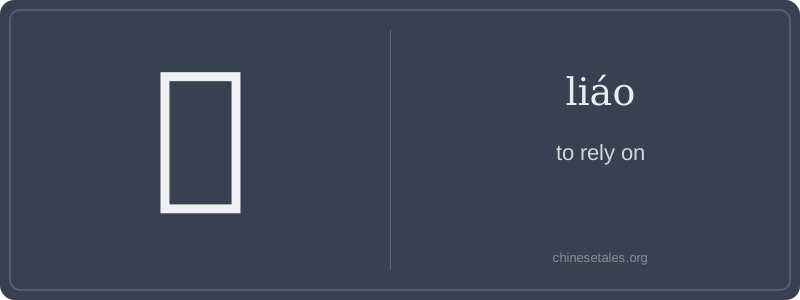
The earliest form of 憀 appears not in oracle bones but in late Warring States bamboo slips and Han dynasty seals, where it emerges as a compound ideograph: the left side 忄 (heart radical) combined with the right side 廌 (zhì) — a mythical one-horned ‘justice beast’ from ancient Chinese legend. Wait — but the modern character shows 廌 replaced by 尞 (liáo), a phonetic component meaning ‘to ascend high, to burn brightly’. That shift happened gradually: scribes simplified 廌 into 尞 for ease of writing, while preserving the sound liáo and retaining the heart radical to anchor its emotional meaning. Visually, the character evolved from a balanced, upright seal script form into a slender, elegant regular script — the heart on the left pulsing quietly beneath the soaring, flame-like strokes of 尞.
This visual evolution mirrors its semantic journey: originally tied to the idea of ‘relying on moral clarity’ (as the zhì beast judged truth), 憀 softened over centuries into a gentler, more introspective concept — dependence not on law or authority, but on inner resonance and trusted presence. In the Wen Xuan (Selections of Refined Literature), it appears in lines like ‘情无所憀,思若悬旌’ (qíng wú suǒ liáo, sī ruò xuán jīng): ‘With emotion having no one to lean upon, thought flutters like a banner on a pole’. Here, 憀 isn’t about control — it’s about vulnerability held with grace.
Think of 憀 (liáo) as the Chinese equivalent of 'leaning on' in the emotional sense — not just physical support, but the quiet, trusting dependence you feel when you rest your head on a friend’s shoulder during a storm. Unlike the more common 依靠 (yīkào), which is neutral and structural (like leaning on a wall), 憀 carries poetic weight: it’s literary, tender, and slightly archaic — the kind of word you’d find in Tang dynasty poetry or a wistful letter from a scholar-official. It almost never appears in spoken Mandarin today; you’ll hear it far more often in classical allusions or modern literary prose trying to evoke elegance or melancholy.
Grammatically, 憀 functions as a verb meaning 'to rely on' or 'to depend on', but it’s almost always used reflexively or with an implied emotional subject — e.g., ‘心无所憀’ (xīn wú suǒ liáo: ‘the heart has nothing to lean upon’) — where the object isn’t stated because the reliance is internal, existential. Learners mistakenly try to use it like 依赖 (yīlài) — inserting direct objects freely — but 憀 resists that. It prefers abstraction, omission, and poetic restraint. You wouldn’t say ‘我憀你’ (I rely on you); you’d say ‘吾心唯憀君之清影’ (My heart relies only on your pure, distant image).
Culturally, 憀 is a linguistic relic that whispers of Confucian relational subtlety: reliance isn’t transactional — it’s dignified, unspoken, and bound up with virtue and resonance (感). Mistaking it for a synonym of 依靠 is like calling a sonnet a grocery list — same parts of speech, utterly different register. And yes — if you use it in daily conversation, your listener might blink, smile faintly, and gently ask if you’ve been reading too much Li Bai.