慵
Character Story & Explanation
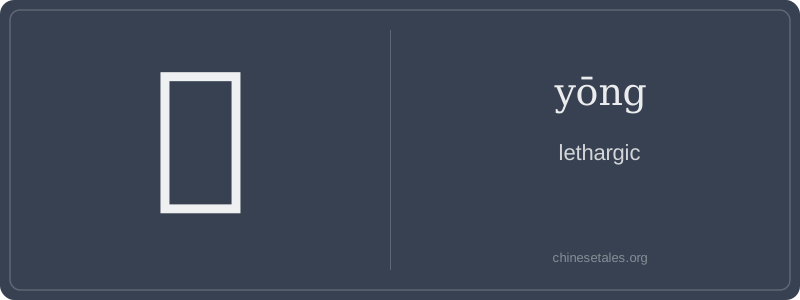
The earliest form of 慵 appears in seal script as a combination of 忄 (heart/mind radical) and 庸 (yōng, ‘common, ordinary, mediocre’). The right side 庸 itself evolved from a pictograph of a mortar (臼) under a roof (广), symbolizing routine, repetitive labor — and thus, by extension, dullness or lack of stimulation. Over centuries, the top of 庸 simplified from 广+用 to ⺍+庸’s modern form, while the left 忄 solidified as the standard heart radical — anchoring the meaning firmly in the realm of inner state, not external action.
This visual logic — ‘heart + ordinary/dull’ — crystallized into the concept of mental slackness: when the mind finds nothing compelling enough to stir it, it settles into a low-energy hum. By the Tang and Song dynasties, poets like Bai Juyi used 慵 to evoke refined idleness — ‘慵梳髻’ (too listless to even tie up one’s hair) — turning physical neglect into a quiet signature of cultivated detachment. The character never meant ‘lazy’ in a judgmental sense; rather, it named the gentle gravitational pull of stillness when the world feels unurgent.
At its core, 慵 (yōng) isn’t just ‘tired’ — it’s the heavy, syrupy kind of lethargy where your limbs feel like wet noodles and even scrolling feels like mountaineering. It’s a literary, slightly poetic word that conveys mental *and* physical sluggishness: not exhaustion from overwork (that’s 累), but a soft, almost luxurious resistance to action — think Sunday morning in bed with no alarm, no guilt, just delicious inertia. You’ll rarely hear it in casual speech; it lives in essays, poetry, and refined descriptions of mood.
Grammatically, 慵 is almost always an adjective, used before nouns (慵懒的午后) or after 是/显得/显得很 (他显得很慵). Crucially, it’s *not* used predicatively without a copula or adverb — you wouldn’t say *‘他慵’* alone (that sounds archaic or broken); instead, it’s ‘他很慵懒’ or ‘他一副慵懒的样子’. Learners often mistakenly treat it like 累 and drop the complement, creating unnatural phrasing.
Culturally, 慵 carries quiet elegance — it’s associated with classical scholar-officials sipping tea while watching clouds drift, not with burnout or depression. That’s why it pairs so naturally with words like 懒 (lǎn, lazy) or 怠 (dài, negligent): 慵懒 implies aestheticized indolence, while 怠 suggests moral failing. A common pitfall? Confusing it with 雍 (yōng, ‘harmonious’) — same sound, totally different world. Also, don’t force it into spoken slang; native speakers reach for 困, 没劲儿, or 懒洋洋 instead.